
It’s a first for the spine experts at Benvenue Medical, Inc…the first American spinal fusion patient in the U.S. has been treated with the company’s new minimally invasive Luna 360 Interbody Fusion System. The surgery was performed by Sandeep Kunwar, M.D., FACS, a neurosurgeon at Washington Township Medical Foundation and an associate clinical professor of Neurological Surgery at the University of California San Francisco, performed the surgery at Washington Hospital in Fremont, California.
First Patient Treated With Luna 360 Fusion System
2 min read Premium comments
Secondary
“The Luna 360 is an important advancement in spinal fusion, ” said Dr. Kunwar in the February 9, 2015 news release. “Its ability to expand in three dimensions allows me to place a large, supporting spacer into the spine while utilizing a very small incision. This minimizes nerve retraction and allows patients to recover more quickly. Incorporating this elegant technology into our spine center is an example of our commitment to providing patients with access to the most advanced treatments available today.”
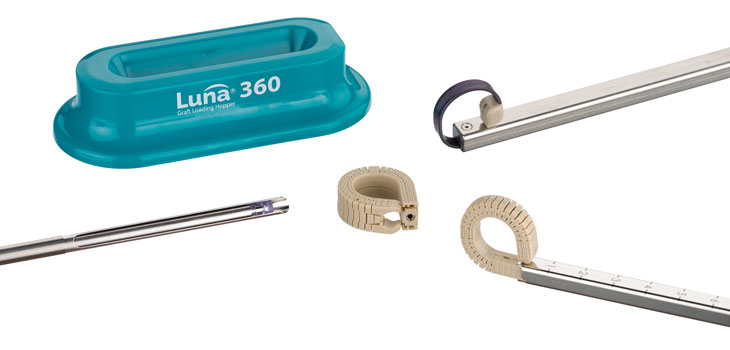
The advantages to the Luna 360, says Benvenue, are myriad. “Luna 360 can be expanded after being placed within the disc space. This mitigates the need to impact a large spacer into the collapsed space, which can damage the vertebral body. Luna 360 is designed to be inserted in a linear, elongated state to minimize tissue retraction and protect the neural structures. Once positioned inside the disc, the implant expands in three dimensions to create a large footprint for stable fixation. Bone grafting is optimized, since graft material is placed into the implant after expansion.”
“The Luna 360 Interbody Fusion System reflects Benvenue Medical’s commitment to developing technologies that improve patient outcomes in spinal repair, ” said Robert Weigle, CEO of Benvenue Medical, Inc. “Washington Hospital’s early adoption of the Luna System demonstrates that hospitals and surgeons are actively seeking out less invasive treatment options for degenerative disc disease.”
Rick Simmons, vice president of sales & marketing at Benvenue, told OTW, “We needed to – and ultimately were able to – take the successful design of the Kiva implant a step further and migrate the platform technology and implant to the lumbar interbody fusion segment. As you recall, the Kiva implant is a circular implant and also made of PEEK-OPTIMA. With Luna, we developed a small access tube and delivery method to make a large circular footprint (vs. competitors’ impacted rectangle shapes) and also make it expand in-situ, yet maintain the strength necessary to support the space between two vertebral bodies to enable fusion. The Luna 360 has significant lifting force – it’s able to lift 200 pounds vertically. Because of that, the Luna 360 is the least invasive access approach, while expanding into the largest footprint on the market today to maximize the bone graft placed after implant expansion.”
React:
Discussion
This is a fascinating development. In my practice we've seen similar outcomes with the revised protocol. The key differentiator seems to be patient selection criteria. Has anyone else noticed the correlation with BMI thresholds?
Great point. I'd push back slightly on the conclusion, the sample size in the cited study is too small to draw population-level inferences. That said, the directional signal is compelling and worth a larger RCT.
We implemented a similar approach last year. Early results are promising but we're still gathering 12-month follow-up data. Happy to share our protocol if anyone is interested.
Join the conversation
Orthopedic professionals are discussing this. Sign in and upgrade to read every comment and add your voice.