
“With cemented TKA, if you have the right skill level, instruments, design, fixation, and the correct implant, then you can guarantee your patients a well fixed TKA, ” says Leo Whiteside. Aaron Rosenberg isn’t so sure about that guarantee. “The registries show a significantly higher rate of revision amongst uncemented knees. Besides, the data is trending towards cementless TKA.”
Whiteside, Rosenberg Debate Cementless, Cemented Revision
7 min read Premium comments
Great Debates
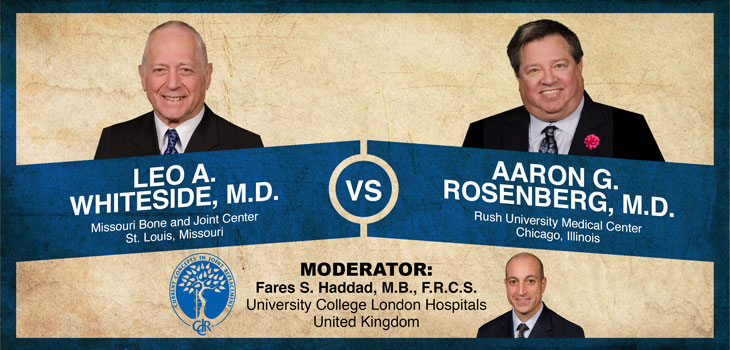
This week’s Orthopaedic Crossfire® debate was part of a landmark event, the first Brazilian CCJR meeting. The event, which took place in September 2014, was held in Iguassu Falls. This week’s Orthopaedic Crossfire® debate is “The Cementless TKA: Lifetime Guarantee on Parts & Labor.” For the proposition is Leo A. Whiteside, M.D. of the Missouri Bone and Joint Center in St. Louis. Against the proposition is Aaron G. Rosenberg, M.D. of Rush University Medical Center in Chicago. Moderating is Fares S. Haddad, M.B., F.R.C.S. from University College London Hospitals in the UK.
Dr. Whiteside: “It’s perfectly reasonable to guarantee total knee replacements (TKR) if they are cementless. Most of what I will discuss today is about the PROFIX knee, something I designed for Smith & Nephew many years ago. If you use intramedullary instruments and the AP axis—and do it well—then you’re going to get them straight pretty much every time. Nothing has replaced intramedullary alignment for fixation; if you use it in the tibia and the femur both then you’re going to get them straight. You use the AP axis…put the femoral head, the patellar groove, and the intercondylar notch in the same plane, then balance the ligaments of the tibia, that’s a winner virtually every time in terms of patellar tracking and ligament balancing.”
“Use the center of the intercondylar notch, the deepest part of the patellar groove. The femoral cutting guides and tibial guides can be made almost failsafe except for cutting ligaments, etc. Tibial intramedullary alignment is helpful and I can pretty much be sure that I have a straight tibial cut. In a study where we looked at all the X-rays, we found 2-7 degrees (and that’s a Pagnano straight knee of +/-3 degrees) from the mechanical axis.”
“The basic design criteria are simple and complex. They need to be wear resistant, have good fixation, and be patella-friendly. And you must be able to get the knee into deep flexion easily and safely. Wear resistant means a large surface contact area, peripheral capture of the polyethylene, and compression molded, gas sterilized material. A short posterior radius is helpful because it puts a large radius of curvature on the posterior aspect of the knee and it avoids edge loading. Also, the shorter radius puts the surface on the back of the knee in a functioning posterior cruciate ligament without rolling off the back.”
“You need a broad surface in the back of the knee to keep it from being damaged. Deep flexion—past 140 degrees—must be accommodated in TKA [total knee arthroplasty]. You need peripheral capture of the metal component and robust polyethylene capture and the correct type of polyethylene. This should be somewhat difficult to get in, press fit, and then get stronger, tougher, more tight fixation as time passes and swelling occurs. You want effective press fixation, full porous coating on the femur and tibia, and then stems and screws if you need them.”
“Without a stem on the tibia you’re going to have to be very careful and limit your cases to only those with hard bone. A stem allows you to broaden your criteria…this will give you fixation in almost any type of bone. Rigid fixation of the femur should require hard driving and be somewhat difficult.”
“We recently published a large clinical series (1, 556 knees)where two of my colleagues and I were operating. We now have 20 year follow up that started with 212 patients and ended up with 13. Patients ranged from 88-101 years of age. That’s one of the reasons why you can guarantee your knees, i.e., because most patients in that age group aren’t that active.”
“The UK registry included 2, 302 patients with cementless PROFIX knees needing revision at 10 years was 1.75%. That outperformed every other knee in the registry, including the cemented PROFIX knee by a significant margin. So if you have the right skill level, instruments, design, fixation, and the correct implant, then you can guarantee your patients a well fixed TKA.”
Dr. Rosenberg: “The data is trending towards more cementless TKA. A study by Merrill Ritter and Michael Meneghini several years ago looked at a large cohort of 20 year survivors using the AGC knee. At 20 years they lost no patients, and had 15 failures (many of them were metal backed)…but two tibia were loose at 1 and 2 years. Their 20 year survivorship with aseptic loosening of any component for revision was only 75%.”
“In a study of patients with contralateral knees—one cemented, one cementless—they had a relatively young mean age of 58 and 14 year mean follow up. They found no significant difference in the clinical scores in either group. Femoral survival was 100% in both groups at 14 years. But again we see a small number of cementless tibias didn’t survive and required early revision. In our experience in the 1980s using cementless total knees there was a 2-3% incidence of tibial components not getting bone ingrowth.”
“Recent work by Michael Meneghini is also concerning. They involved 106 consecutive posterior stabilized cementless porous tantalum tibias. In some registries these tibias have done extremely well, but here was a cohort with nine failures at a mean of 18 months. The characteristic failure mode was medial tibial collapse. If you look at the failed implants versus the well functioning ones, the former were taller, weighed more, and had more, earlier failures in tall, heavy males.”
“In a recent review for the Cochran database the authors looked at five randomized controlled clinical trials with 297 patients. There was almost no difference between groups in terms of the knee scores, but radiostereometric analysis studies showed that cemented tibias had smaller displacements. And Swedish registry data shows a significant difference between the cemented and cementless total knees. They did a Cox regression model adjusting for age, gender, year of operation and patellar component; the revision risk for the uncemented tibia was about 1.5x greater than it was for cement.”
“The New Zealand registry shows about a 50% increase in component revision per 100 years of implantation (uncemented versus cemented). The UK registry shows a significantly higher rate of revision amongst uncemented knees at five years; the Australian registry shows a significantly higher revision rate per 100 years. Finally, the cumulative revision rate at 10 years is higher. So over the short to intermediate term there is a small advantage. The younger the patient the more incentive there might be for cementless fixation…but in registry studies younger patients are at a higher risk for revision (for either fixation).”
“As the polyethylene improves and wear issues diminish the advantage of removing cement from the construct may increase. Leo, let’s compromise. Let’s agree to respect each others’ views…no matter how wrong yours may be.”
Moderator Haddad: “If you look at what’s happened what with hip replacement you see that the world has gone cementless. Yet in North America cementless knees still aren’t the standard of care.”
Dr. Whiteside: “It took Ignaz Semmelweis about 100 year to convince obstetricians to wash their hands between deliveries and they finally drove him into an insane asylum. I figure that’s where I’ll end up…with your help.”
Dr. Rosenberg: “I’ll go with you. Look, at the end of the day I think there is some merit to the concept of eliminating cement. Two things that concern me: Is cement protective of the interface in the situation when you get particulate debris? Our evidence says that it is…and that when you use cemented components you’re less likely to get the infected joint space attacking the implant interface. Also, the fact that it’s biologic and requires a time period in which fixation occurs means that when you first place the implants they’re not securely fixed. You must securely fix them with an interference fit. And until they get ingrowth there is a possibility that they won’t get biologic fixation.”
Dr. Whiteside: “I was sad to see Meneghini’s article on failure fixation of the tibial component. The biomechanical data are so clear. Going back to Insall and Burstein we knew that you can’t get by without good fixation. Then there’s Merrill Ritter’s study showing that a flexible tibial tray will sink into the tibial bone. If you’re going to use cementless fixation you had better have good biomechanics.”
Dr. Rosenberg: “The question in my mind is, ‘Will there come a time when we add some biologic component to the underlying physiology of knee replacement without cement?’ About 10 years ago when it became more popular to do surface cementing of the tibial components only and no cementing of the tibial keel, for example, I encountered a lot of patients who were referred to me for persistent pain. Also, a number of patients who have ingrowth of cementless components, but have persistent pain, we revise them to cemented components and they get dramatically better. Retrieval studies show that the amount of fixation interface that actually occurs is quite variable. And particularly on the tibial side the amounts are rarely beyond more than 20% of the interface that are fixed. And there may be variability in the degree to which people feel that this interface is comfortable.”
“The beauty of cementless is that ideally you get remodeling of the bone over time. The problem is that the cementless application narrows the window of performance, so to speak, so that it may make it more difficult for a larger community of surgeons to get acceptable results.”
Moderator Haddad: “The mark of two fantastic surgeons is that the moderator had to do absolutely nothing during the debate. Thank you, gentlemen.”
Please visit www.CCJR.com to register for the 2015 CCJR Spring Meeting, May 17 – 20 in Las Vegas.
React:
Discussion
This is a fascinating development. In my practice we've seen similar outcomes with the revised protocol. The key differentiator seems to be patient selection criteria. Has anyone else noticed the correlation with BMI thresholds?
Great point. I'd push back slightly on the conclusion, the sample size in the cited study is too small to draw population-level inferences. That said, the directional signal is compelling and worth a larger RCT.
We implemented a similar approach last year. Early results are promising but we're still gathering 12-month follow-up data. Happy to share our protocol if anyone is interested.
Join the conversation
Orthopedic professionals are discussing this. Sign in and upgrade to read every comment and add your voice.