
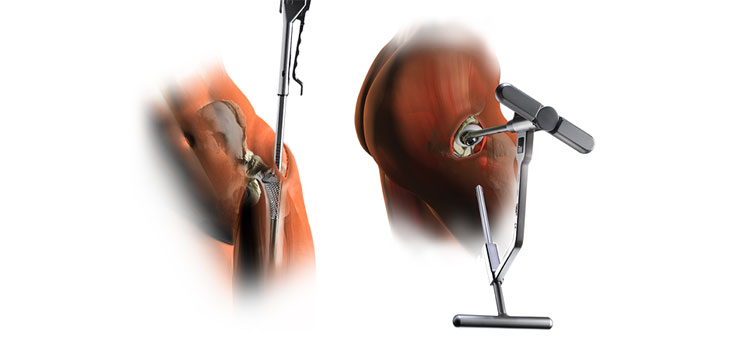
MicroPort Orthopedics Inc., a global producer of orthopedic implant products, reports that Jimmy Chow, M.D., has performed over 1, 000 total hip arthroplasty surgeries using the firm’s Supercapsular Percutaneously Assisted Total Hip approach. Called SuperPath, this technique is a modification of the standard posterior hip approach that offers special treatment of the soft tissues surrounding the hip.
Surgeon Passes 1, 000 Arthroplasty Milestone using SuperPath
1 min read Premium comments
Secondary
The company maintains that this approach facilitates a faster return to function and independence for patients. Among benefits claimed is a decreased operative time, decreased blood loss and decreased post-operative recovery time. The resulting benefit to patients and surgeons is fewer post-operative restrictions.
Brad Penenberg M.D. and Stephen Murphy, M.D., developed the SuperPath Hip technique and launched it in 2010. Penenberg is a member of the attending staff at Cedars-Sinai Medical Center in Los Angeles and serves as an Assistant Professor at the University Of Southern California School Of Medicine and the Tufts University School of Medicine.
Murphy is an orthopedic surgeon at New England Baptist Hospital and Associate Professor of Orthopaedic Surgery at Tufts University School of Medicine. He was one of the first American surgeons to popularize the use of peri-acetabular osteotomy for hip dysplasia and was the first to publish on the topic of femoroacetabular impingement.
MicroPort Orthopedics of Arlington, Tennessee, was formerly the large joint business of Wright Medical Group, Inc. and is now a division of Shanghai based MicroPort Scientific Corporation.
Author
React:
Discussion
This is a fascinating development. In my practice we've seen similar outcomes with the revised protocol. The key differentiator seems to be patient selection criteria. Has anyone else noticed the correlation with BMI thresholds?
Great point. I'd push back slightly on the conclusion, the sample size in the cited study is too small to draw population-level inferences. That said, the directional signal is compelling and worth a larger RCT.
We implemented a similar approach last year. Early results are promising but we're still gathering 12-month follow-up data. Happy to share our protocol if anyone is interested.
Join the conversation
Orthopedic professionals are discussing this. Sign in and upgrade to read every comment and add your voice.