
Spinal Elements, Inc. has announced that they recently received clearance through the FDA for a full line of interbody devices with Ti-Bond coating for use in the cervical spine. The company intends to make the product available starting in the first quarter of 2015.
Spinal Elements Gets FDA Clearance for Devices With Ti-Bond
1 min read Premium comments
Secondary
According to the January 21, 2015 news release, the “Ti-Bond coating consists of titanium with random, unconnected pores that is mechanically adhered through a plasma vacuum spray process to the superior and inferior surfaces of its PEEK-OPTIMAinterbody implants. This results in a porous titanium bone-opposing surface while allowing for direct visualization of the fusion mass through the radiolucent PEEK material.”
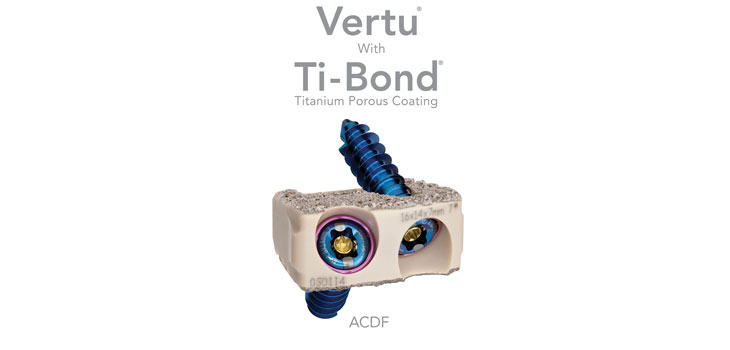
“The clearance included the addition of Ti-Bond to the company’s Crystal Cervical Interbody devices as well as their two stand-alone cervical implants—Mosaic and Vertu, a no profile stand-alone device.”
Company CEO Todd Andres commented in the news release, “This clearance and launch further establish Spinal Elements’ lead in the advancement of new technologies and materials in the interbody spinal fusion space, and will help fuel the excitement and growth we have seen related to our Ti-Bond devices.”
Jason Blain, company president, told OTW, “The addition of Ti-Bond to our cervical portfolio of interbody products helps complete our catalog of PEEK interbody devices offered with Ti-Bond. We’ve seen tremendous growth in our Ti-Bond lumbar interbody products since introducing that format two years ago. We expect to see continued adoption of the technology with this new implementation. Adoption of Ti-Bond has been particularly strong in our stand-alone, no profile devices and we are seeing a high demand for our Ti-Bond stand-alone cervical solution, Vertu.”
Author
React:
Discussion
This is a fascinating development. In my practice we've seen similar outcomes with the revised protocol. The key differentiator seems to be patient selection criteria. Has anyone else noticed the correlation with BMI thresholds?
Great point. I'd push back slightly on the conclusion, the sample size in the cited study is too small to draw population-level inferences. That said, the directional signal is compelling and worth a larger RCT.
We implemented a similar approach last year. Early results are promising but we're still gathering 12-month follow-up data. Happy to share our protocol if anyone is interested.
Join the conversation
Orthopedic professionals are discussing this. Sign in and upgrade to read every comment and add your voice.