
According to a December 26 article, on November 27, 2014, Rong-Min Baek, M.D. received the Audrey Hepburn Humanitarian Award (AHHA) at the Dongdaemun Design Plaza in Seoul. Dr. Baek, a plastic and reconstructive surgeon, has spent the past 25 years offering his skills and time to help children in Korea and abroad.
Rong-Min Baek, M.D. Wins Prestigious Audrey Hepburn Humanitarian Award
2 min read Premium comments
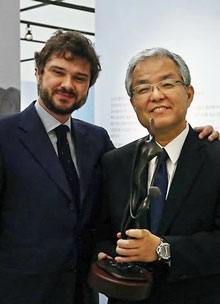
The Audrey Hepburn Humanitarian Award recognizes individuals and organizations that have made significant contributions to better the lives of children worldwide. Luca Dotti, Hepburn’s son and the co-chairman of the Audrey Hepburn Children’s Fund, presented Dr. Baek with the award for his years of dedication and service. Dr. Baek, a surgeon at Seoul National University Bundang Hospital, is the first Korean to win the AHHA.
“It is glorious, but I only did what I had to do, ” Dr. Baek said to The Korea Times. “Children should not be scarred by their looks. I would like to return the smiles back to more children in need.”
In 1989, Dr. Baek and his elder brother, Se-Min Baek, M.D., created a small charity to help children in need.
“I and my brother visited public health centers all over the country every weekend to perform operations on children with facial deformities, ” Dr. Baek said.
This charity developed into Smile for Children in 1995. Smile for Children performs surgeries on children with craniofacial abnormalities and has since expanded internationally and performed over 3, 700 operations. In the past 20 years, over 100 peer-surgeons have travelled to Vietnam, Myanmar, Indonesia, Uzbekistan, and Mongolia to perform surgeries.
In 2014 alone, Dr. Baek travelled to Vietnam, Myanmar, and Indonesia where he supervised over 200 surgeries. Dr. Baek even met with North Korean officials in 2000 in an attempt to help North Korean children.
“It may not be easy, but I believe I can meet North Korean children one day, ” he said.
Although the relationship between the two Koreas has since deteriorated, Dr. Baek remains hopeful that he can one day better the lives of North Korean children with facial deformities.
“I feel most rewarded when I see children take their smile back after the operation, ” Dr. Baek said.
Author
React:
Discussion
This is a fascinating development. In my practice we've seen similar outcomes with the revised protocol. The key differentiator seems to be patient selection criteria. Has anyone else noticed the correlation with BMI thresholds?
Great point. I'd push back slightly on the conclusion, the sample size in the cited study is too small to draw population-level inferences. That said, the directional signal is compelling and worth a larger RCT.
We implemented a similar approach last year. Early results are promising but we're still gathering 12-month follow-up data. Happy to share our protocol if anyone is interested.
Join the conversation
Orthopedic professionals are discussing this. Sign in and upgrade to read every comment and add your voice.