
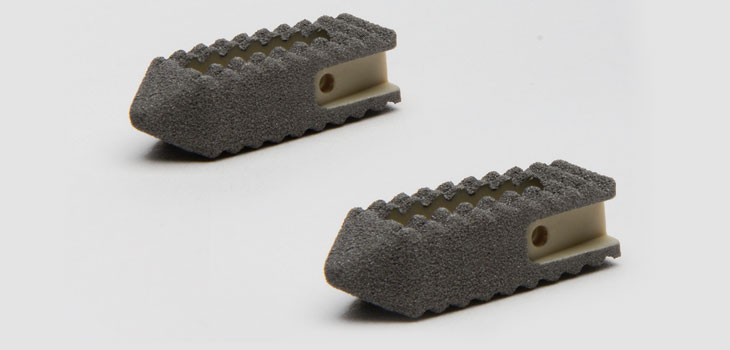
Aesculap Implant Systems, LLC has introduced a new interbody system for PLIF (posterior lumbar interbody fusion) procedures which combines an osteoconductive porous titanium coating with a PEEK radiolucent core.
New Interbody System From Aesculap
1 min read Premium comments
Secondary
ProSpaceXP System
According to a January 21, 2015 company statement, the ProSpaceXP Interbody System features the company’s “innovative” PlasmaporeXP osteoconductive porous titanium coating with the PEEK core to deliver, “enhanced implant stability, artifact-free imaging, and an optimal, osteoconductive scaffold for fusion procedures.” The coating allows for maximum contact area between the implant and vertebral endplate.
Unique Coating
The company claims the design of the system, “combines aggressive teeth and the PlasmaporeXP surface coating that enhances implant stability and migration resistance.” Additionally, the company says the system maximizes the contact area between the implant and vertebral endplate, “offering surgeons the ideal scaffold for a stable fusion.” The company says the system also has excellent imaging properties, “incorporating the benefits of the PlasmaporeXP coating, which clearly delineates implant contours during imaging, along with X-Ray marker pins for intraoperative positioning and verification.”
Ovine Study Results
A 2013 ovine study released by the company and authored by Boyle C. Cheng, Ph.D. stated that PlasmaporeXP coated implants “have significantly greater pullout strength and bony ingrowth when compared to uncoated PEEK implants at 12 and 24 weeks.” The study, according to the company, also concluded that the coating “presents a biomechanical advantage by providing initial stabilization as well as long term advanced stability.”
The study examined comparative histological results at multiple time points between PlasmaporeXP coated implants and PEEK implants. New bone formation, bony apposition, inflammation, and fibrosis were measured as a percentage of each ovine bone sample.
In summary, according to the company, both new bone formation and bony apposition were greater for the PlasmaporeXP coated implants than the PEEK implants irrespective of time. In addition, significantly less inflammation and fibrosis was detected for the PlasmaporeXP coated samples compared to the PEEK samples at all time points.
The system includes a comprehensive range of “intuitive” instrumentation and over 40 implant size options are available to accommodate varying patient anatomies and intraoperative needs.
Author
React:
Discussion
This is a fascinating development. In my practice we've seen similar outcomes with the revised protocol. The key differentiator seems to be patient selection criteria. Has anyone else noticed the correlation with BMI thresholds?
Great point. I'd push back slightly on the conclusion, the sample size in the cited study is too small to draw population-level inferences. That said, the directional signal is compelling and worth a larger RCT.
We implemented a similar approach last year. Early results are promising but we're still gathering 12-month follow-up data. Happy to share our protocol if anyone is interested.
Join the conversation
Orthopedic professionals are discussing this. Sign in and upgrade to read every comment and add your voice.