
The United States Senate and House of Representatives each have a new Republican physician among their 74 newest members following the recent mid-term elections.
New Docs in Congress
3 min read Premium comments
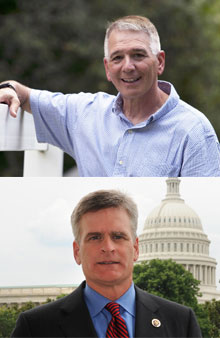
If history is any guide, physicians shouldn’t expect Congressman Ralph Abraham, M.D. or Senator Bill Cassidy, M.D. to cast their votes in favor of physician backed legislation such as the “Doc Fix” or other healthcare issues. Current House and Senate leadership includes physicians, but they typically vote along party, not professional lines. Senator Cassidy was an assistant majority whip while serving in the House in the last Congress.
Drs. Abraham and Cassidy are both from Louisiana.
Congressman Ralph Abraham, M.D.
Congressman Abraham, along with his M.D., is also a veterinarian, flight instructor and aviation medical examiner. He received his degrees from Louisiana State University and is known as a rural doctor who can, self admittedly, “treat anything on four legs.” In his Republican primary campaign, he defeated Zach Dasher, the nephew of Duck Dynasty’s Phil Robertson, an ardent tea-party advocate.
According to the National Journal, Abraham originally trained to be a veterinarian but changed careers in his late 30s to become a physician. He serves in the Coast Guard Auxiliary and works as a volunteer pilot with Pilots for Patients, a group providing free air transportation to people needing medical assistance who live far from hospitals or doctors.
Senator Bill Cassidy, M.D.
Senator Cassidy moved to the U.S. Senate from the U.S. House after defeating Democratic incumbent Senator Mary Landrieu in a December 2014 run-off election.
Like Congressman Abraham, he also received his M.D. from Louisiana State University where he has been an assistant and associate professor of medicine since 1990. He is an internist and hepatologist and a cofounder the Greater Baton Rouge Community Clinic, which provides free dental and health care to the working uninsured. He developed a school-based hepatitis B vaccination program that has immunized more than 36, 000 public and private schoolchildren at no cost to parents or schools.
Cassidy made a mark when Hurricane Katrina hit in 2005. He reportedly created a makeshift field hospital with the help of several other physicians in an abandoned Kmart store. In a PBS documentary, he recalled entering the store after the storm to discover grease covering the floor, no electricity, and no working phone lines. In two days, he and the others transformed the space to be ready to receive patients.
Cassidy, according to the National Review, describes himself as a “pro-life, pro-gun-rights” social conservative in favor of free enterprise, limited government, and lower taxes. He likes highlighting his record in the state Senate of voting against spending bills and cutting taxes for businesses and for parents with children in private schools.
After being elected to the U.S. House in 2009, Cassidy, along with fellow physician and Louisiana GOP colleague Charles Boustany, was given a seat on the Energy and Commerce Committee. He was frequently called on to publicly criticize the Obama administration on healthcare. Cassidy said the government should step out of the way of patients, and he supports providing incentives for preventive care along with creating health savings accounts.
“I favor giving the patient the power; that is the opposite of Obamacare, ” he said in an October 2012 speech. “When you have your own insurance policy you have the power. If you are dependent upon the government to give you insurance, you do not.” He introduced a bill intended to increase access to life-saving prescription drugs by seeking to more accurately match Medicare reimbursement rates for those drugs in the hope of encouraging manufacturers to increase production. He also supported Congressman Paul Ryan’s plan to overhaul Medicare, and he introduced legislation in 2012 to reduce the share that states pay for Medicaid.
The new members all take an oath to uphold the Constitution. We’re not sure about the Hippocratic Oath of “Primum non nocere.”
Author
React:
Discussion
This is a fascinating development. In my practice we've seen similar outcomes with the revised protocol. The key differentiator seems to be patient selection criteria. Has anyone else noticed the correlation with BMI thresholds?
Great point. I'd push back slightly on the conclusion, the sample size in the cited study is too small to draw population-level inferences. That said, the directional signal is compelling and worth a larger RCT.
We implemented a similar approach last year. Early results are promising but we're still gathering 12-month follow-up data. Happy to share our protocol if anyone is interested.
Join the conversation
Orthopedic professionals are discussing this. Sign in and upgrade to read every comment and add your voice.