
K2M Holdings, Inc. announced on January 21, 2015 that the FDA granted 510(k) clearance for the company’s MESA 2 Deformity Spinal System.
K2M’s Newest Pedicle Screw System Cleared for Marketing
1 min read Premium comments
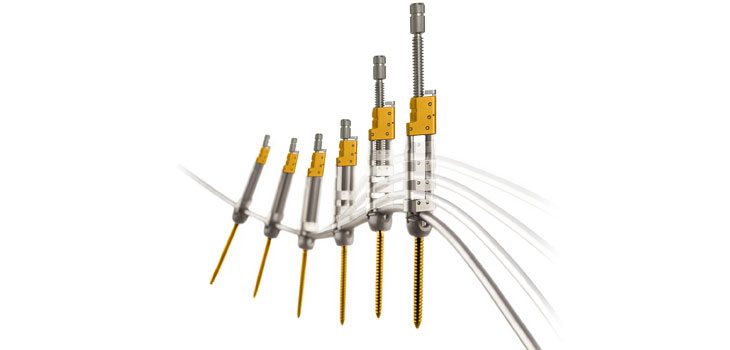
Secondary
The system is the company’s next-generation pedicle screw system.
According to the announcement, the system features the “next-generation MESA 2 screw, a top-loading, low-profile screw that offers a dual-lead thread pattern for fast insertion. K2M’s MESA Technology also features Zero-Torque Technology, which offers surgeons the ability to one-step lock without torsional stress being applied to the spine. Both deformity polyaxial and uniplanar screws are available in this new system.”
Laurel C. Blakemore, M.D., chief and associate professor of pediatric orthopaedics in the department of orthopaedics at the University of Florida, said, “Compared to its predecessor, MESA 2’s dual-lead thread provides the opportunity for quicker screw insertion and the on/off button on the Crickets provide an easier way for the Crickets to latch on to the MESA head to help save time during correction.”
The company says the new Quick Cricket, provides “quick on/off capabilities, while correcting the spine in all three planes. Additionally, the Over Cricket Final Locker allows for one-step locking over the Cricket, thus eliminating the need to partial lock.”
Products and Distribution
Since its inception 11 years ago, the company has developed approximately 60 spinal technologies and related techniques. It sells its products through over 120 direct sales employees and approximately 66 independent sales agencies. The company does not sell through physician-owned distributors (PODs). The company also markets and sells its products internationally in 29 countries with products sold directly in markets such as the United Kingdom and Germany and through independent distributors in other markets such as Australia, Japan and Spain.
Author
React:
Discussion
This is a fascinating development. In my practice we've seen similar outcomes with the revised protocol. The key differentiator seems to be patient selection criteria. Has anyone else noticed the correlation with BMI thresholds?
Great point. I'd push back slightly on the conclusion, the sample size in the cited study is too small to draw population-level inferences. That said, the directional signal is compelling and worth a larger RCT.
We implemented a similar approach last year. Early results are promising but we're still gathering 12-month follow-up data. Happy to share our protocol if anyone is interested.
Join the conversation
Orthopedic professionals are discussing this. Sign in and upgrade to read every comment and add your voice.