
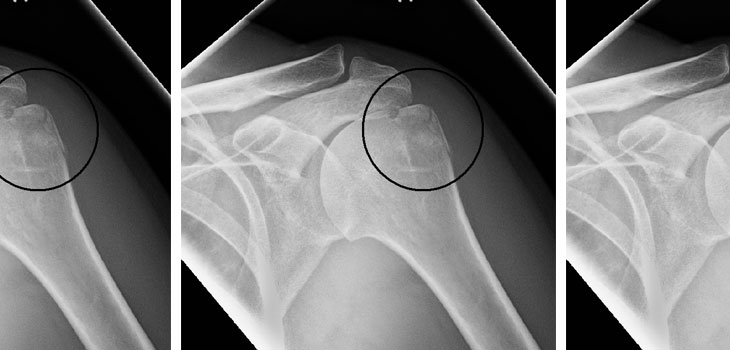
As if growing old, itself, were not bad enough, a study has found that concomitant rotator cuff tears in association with proximal humerus fractures are relatively common and are associated with older patients—as well as those with a fracture-dislocation.
Humerus Fractures = Rotator Cuff Tears?
1 min read Premium comments
Secondary
As reported by Orthopedics Today, researchers reviewed data from 345 patients who underwent surgery for 349 proximal humerus fractures from January 2007 to June 2012. They looked at patient demographics and how the patients’ rotator cuff tears had been treated. Then they did a regression analysis.
The researchers found that 8.6% of the patients had had concomitant rotator cuff tears. When they compared these patients with those who had not had a rotator cuff tear, they found that those who had had one were not only older, but were more likely to have had an arthroscopic repair or even a reverse shoulder arthroplasty.
At the time of the surgery, doctors treated 22 of 30 patients with suture repair. Five went on to get reverse total shoulder arthroplasty based on the intraoperative finding of a significant rotator cuff tear, according to the Orthopedics Today report.
Author
React:
Discussion
This is a fascinating development. In my practice we've seen similar outcomes with the revised protocol. The key differentiator seems to be patient selection criteria. Has anyone else noticed the correlation with BMI thresholds?
Great point. I'd push back slightly on the conclusion, the sample size in the cited study is too small to draw population-level inferences. That said, the directional signal is compelling and worth a larger RCT.
We implemented a similar approach last year. Early results are promising but we're still gathering 12-month follow-up data. Happy to share our protocol if anyone is interested.
Join the conversation
Orthopedic professionals are discussing this. Sign in and upgrade to read every comment and add your voice.