
Cartiva, Inc. claims to have the first intramedullary hammertoe implant designed to maintain continuous bone-to-bone contact through a unique suture locking system.
Hammertoe Correction System Gets FDA Clearance
2 min read Premium comments
Secondary
And now American patients will have access to the company’s ProxiFuse Hammertoes Correction System after the FDA granted the company 510(k) clearance to market the system in the United States.
According to the company’s January 7, 2015 announcement, hammertoes are one of the most common deformities of the lesser toes where the second, third or fourth toe cause the toe to bend at the middle joint instead of pointing forward. In the U.S., approximately 600, 000 annual surgical implant procedures are performed to treat hammertoes.
The common intervention is to fuse the joint after the ends of the bone are cut and the toes is straightened out. Pins, screws or other implants are used to keep the toe straight while the bone ends heal together. While multiple fixation methods have been used to keep the correction stable, the most common method has traditionally been the use of a pin-like device known as a Kirschner wire, or “K-wire.” The company says K-wires have been associated with complications including broken hardware, loosening, bending, migration and pin tract infection. Furthermore, patient dissatisfaction can be high as the K-wire protrudes from the tip of the toe during the four to six week healing process.
ProxiFuse System
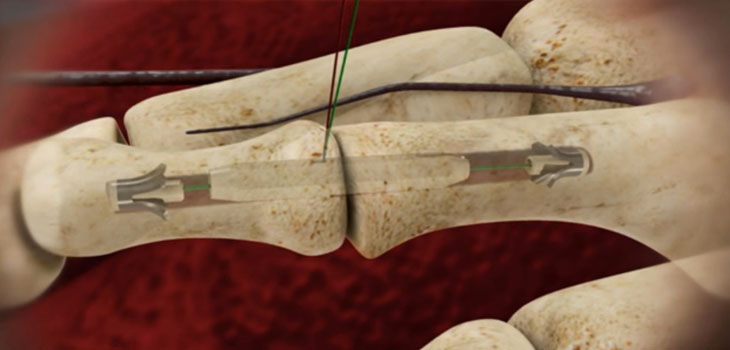
The ProxiFuse system is specifically developed for fusion surgery and is used for the fixation of osteotomies and reconstruction of the lesser toes following correction procedures for hammertoe, claw toe and mallet toe. Tiny Nitinol anchors on each side of the joint are secured into the bone, connected by a strong, self-locking suture fiber. Once tightened, the system, according to the company, “is designed to deliver continuous compression across the joint to be fused. A small PEEK body provides rigidity across the fusion site.”
According to instructions on the company’s website to surgeons, “Using the graduated bone awl and disposable delivery instrument that are included in the tray, the surgeon inserts the anchors on each side of the PIP (proximal interphalangeal) joint. With the PEEK body to guide and stabilize the implant, the two sides are compressed by pulling the suture. The PEEK body’s ability to be repositioned after insertion results in a lower amount of soft tissue release required to realign the middle phalanx compared to other intramedullary devices.”
“The proprietary knot system holds the compressed bones together throughout the recovery period, reducing the likelihood of malunion.”
Timothy Patrick, president and chief executive officer of Cartiva said, “We believe our system resolves many of the shortcomings of existing products, such as fixation and stability.”
Alpharetta, Georgia-based Cartiva was founded in 2011 after spinning out from Carticept Medical, Inc.
Author
React:
Discussion
This is a fascinating development. In my practice we've seen similar outcomes with the revised protocol. The key differentiator seems to be patient selection criteria. Has anyone else noticed the correlation with BMI thresholds?
Great point. I'd push back slightly on the conclusion, the sample size in the cited study is too small to draw population-level inferences. That said, the directional signal is compelling and worth a larger RCT.
We implemented a similar approach last year. Early results are promising but we're still gathering 12-month follow-up data. Happy to share our protocol if anyone is interested.
Join the conversation
Orthopedic professionals are discussing this. Sign in and upgrade to read every comment and add your voice.