
FREE Software Accurately Predicts Surgical Outcomes 97% of the Time
FREE Software Accurately Predicts Surgical Outcomes 97% of the Time // 86% of Soldiers Return to Duty After Joint Surgery // and More!
5 min read Premium comments
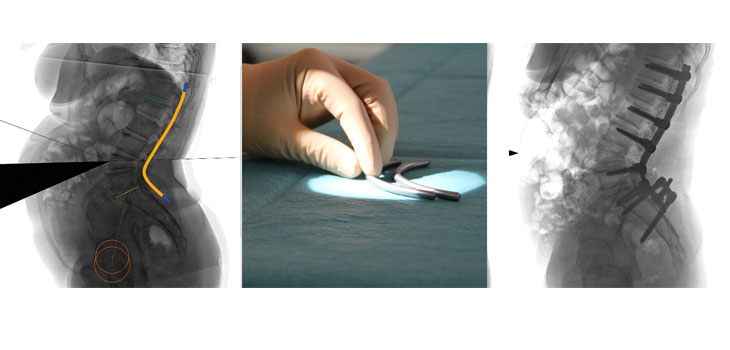
“Why didn’t they do it before, ” you might think. In the words of Frank Schwab, M.D., his team succeeded by connecting the dots. Dr. Schwab, Chief of the Spinal Deformity Service at New York University’s Langone Medical Center, recently implanted the first customized osteosynthesis rod precisely designed and manufactured to properly realign the individual’s spine. Dr. Schwab is the founder/CEO, board member, and a significant equity holder of Nemaris, Inc., developer of Surgimap, the dedicated software platform used by Medicrea Group for producing this new patient specific device (UNiD rod).
Dr. Schwab told OTW, “Even in residency I was drawn to spinal deformity because there wasn’t much clarity, and thus great opportunity to optimize outcomes or standardize approaches for dealing with a wide variety of deformity problems. As data emerged from multicenter studies we began to see that there are clear patterns of deformity. I collaborated with the Scoliosis Research Society (SRS) and we developed the definitive adult deformity classification system that was based on function and pain.”
“We were able to look at patients’ progress one, two and three years after surgery and to recognize the essential drivers of what determines good outcomes. So much depends on the way we align the key components of the spine. And if we can reach a point of harmony between the shape of the pelvis, lumbar lordosis, and thoracic kyphosis then we can determine the patients’ necessary global alignment. At its core it is a mathematical equation…and our goals need to vary from patient to patient.”
And it works well enough that the SRS has adopted it. “Using this software—Surgimap, which is available for free online—we can accurately measure, simulate surgical realignment and implant needs. In addition, algorithms have been developed that let us predict outcomes in over 85% of cases. In a pre-op meeting with the patient we take the image, simulate the surgical correction, and click the patient specific rod order button. At that point Medicrea is prompted to make a custom patient specific rod in titanium or cobalt chromium alloy that is made in the exact shape needed by the patient (typically lead time 7 days). It takes a great deal of guesswork out of the OR. Ideally, surgeons don’t have to stand around saying, ‘We may need a little more curvature here…and is the rod bend in the right place?’ Up to now, surgeons had to use their hands to bend these very stiff fusion rods and just assume that they were able to form it into the correct shape—but they were never sure if that’s what the patient really needs.”
Surgimap has taken the guesswork out of the process, says Dr. Schwab, resulting in shorter OR time and sets the stage for better patient outcomes. “To date over 100 surgeries have been done using the Medicrea UNiD rod in conjunction with Surgimap, most of which have been in Europe. After the recent FDA approval, however, more and more are being performed here in the U.S. This is a major step forward. It is a translational technology that links science and patient specific planning to improved operative performance. This raises the bar substantially for surgeons and patients. What has prevented others from developing this? There was insufficient clinical data, the algorithms weren’t ready, an adapted planning software was lacking…and this all had to be combined and meet with approval by the FDA. This has finally been accomplished. And it’s a great thing for our patients”
Soldiers’ Careers Don’t Have to End After Joint Surgery
“Your career is done, ” are the words that veterans who have had joint arthroplasty often heard in the past. Thanks to Tad Gerlinger, M.D., an orthopedic surgeon at Midwest Orthopaedics at Rush and winner of a Bronze Star, soldiers with knee injuries can return to their military careers. Dr. Gerlinger tells OTW, “In the near past, undergoing a hip or knee replacement would disqualify you from future military service. What a waste this is. We have this vast cadre of experienced, senior people who have had to go in front of a medical evaluation board in order to prove that they are sufficiently fit for service. Given our new technologies and techniques, however, we are increasingly able to return people to their active lifestyles.”
“This retrospective study, conducted at the San Antonio Military Medical Center, explored the likelihood of soldiers to return to duty following total joint arthroplasty. We found that 86% of patients were able to return to duty, despite the strenuous lifestyle involved; of those, 70% were deployed to the combat zone and completed a full tour as assigned. Overall, it’s been exciting to see people such as military pilots and special operations soldiers reclaiming their careers. Those who have undergone total joint surgery no longer have to stand before a board and explain their situations.”
Growing Discs Outside the Body
Jeff Wang, M.D. and his team are up to some interesting things in California. Dr. Wang, a professor of orthopedic surgery and neurosurgery at the Keck School of Medicine at the University of Southern California, is pushing the envelope when it comes to growing cells. Dr. Wang tells OTW, “There are a number of researchers working on collagen matrices; others are trying to get cells in the disc to transform into growth factors. This goes beyond that work.”
Zori Buser, Ph.D. of the University of Southern California, elaborates: “In our recent pilot study we used 3D printed scaffolds to grow bovine nucleus pulposus cells and watched closely to see if the cells ‘liked’ that environment and would continue growing and building extracellular matrix. Using animal cells for bench studies has advantages such as sufficient numbers and the healthy culture. Furthermore, the bovine cells are to the certain extent similar to human cells so that will be helpful in translating the results. Using healthy cells is the best way to test a scaffold because we want to know if those cells can survive in an artificial environment. We will then go back and harvest the human cells in various stages of degeneration. The issue becomes that when you are dealing with those that are not healthy then you really don’t have many cells to work from. As we know intervertebral disc is an acellular organ and it is difficult for cells to overcome the degeneration and rebuild the matrix on their own. Additionally the human disc environment has a very low pH and oxygen, so trying to replicate those conditions is always a challenge.
“The 3D printing aspect is very appealing because of the reproducibility. It means we can make hundreds of the same scaffolds without adjusting the chemistry or biology. Our scaffold is a round mesh with different pore sizes and shapes to mimic the disc environment in vivo. In analyzing the initial data we found that this first scaffold is stiff but that the mesh shape plays a role in cell proliferation. The next step will be to combine our 3D scaffolds with one of the matrix proteins (crosslink with collagen) providing a more natural environment to the nucleus pulposus cells.”
Dr. Wang adds, “We have just received IRB [institutional review board] approval to do this work using human disc cells from our patients. Our ultimate goal is to be able to grow the disc outside the body and then implant it into the nucleus. We don’t yet know how we will attach it to the bone, but we will be addressing that in the near future.”
React:
Discussion
This is a fascinating development. In my practice we've seen similar outcomes with the revised protocol. The key differentiator seems to be patient selection criteria. Has anyone else noticed the correlation with BMI thresholds?
Great point. I'd push back slightly on the conclusion, the sample size in the cited study is too small to draw population-level inferences. That said, the directional signal is compelling and worth a larger RCT.
We implemented a similar approach last year. Early results are promising but we're still gathering 12-month follow-up data. Happy to share our protocol if anyone is interested.
Join the conversation
Orthopedic professionals are discussing this. Sign in and upgrade to read every comment and add your voice.