
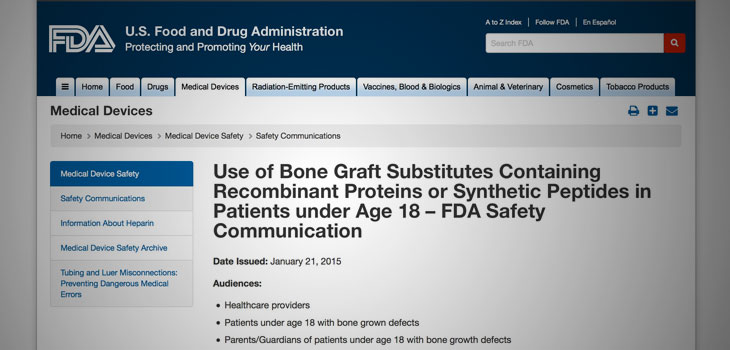
Stop the routine use of bone graft substitutes containing recombinant proteins or synthetic peptides high-risk (Class III) medical devices in patients under 18 years of age, warns the Food and Drug Administration (FDA).
FDA Issue “Safety Communication” Over Certain Bone Graft Substitutes
2 min read Premium comments
Secondary
On January 21, 2015, the agency issued a “Safety Communication – Reports of Serious Injury, ” because reports of serious injuries, “such as excess bone growth, fluid accumulation, inhibited bone healing, and swelling, ” have increased the agency’s concern.
Younger Patients – Added Risks
These reports of injuries, says the agency, are of special concern because patients under 18 are typically smaller and their bones are still growing. “Any product that affects bone growth could have the potential to negatively impact skeletal development by altering normal bone formation and growth, especially if implanted near open growth plates.” The agency also said that before marketing such products, companies need to submit a premarket approval application (PMA) with clinical data.
The agency says certain recombinant proteins and synthetic peptides “mimic bone growth substances normally found in the body and may be added to a carrier or scaffold to be used as bone graft substitutes. Once combined, these products are surgically implanted in a patient with a bone defect to promote new bone growth or to replace or heal existing bone.”
The products have been approved for orthopedic and dental use only in patients over the age of 18 who are done growing (skeletal mature). The labeling for each product provides the specific indications for use.
According to the agency, because younger patient’s bodies are still growing, vital organs and tissues are closer together than in a body that is done growing. “This could potentially allow small changes from one organ/tissue to have serious effects on another. For example, there is less space between the spinal cord and the bones surrounding it. If one of these products is used in the spine of a patient under age 18, who then experiences the same amount of excess bone growth or fluid accumulation as a patient over age 18; it may more easily lead to spinal nerve injury, pain, or weakness.”
Recommendations
The FDA offers four recommendations:
- NO “routine use of these products in patients under age 18 because their safety and effectiveness has not been reviewed or approved for use in this population.”
- “Consider alternatives such as autograft bone, allograft bone, and bone graft substitutes that do not contain recombinant proteins or synthetic peptides before using bone graft substitutes containing recombinant proteins and synthetic peptides in patients under age 18.”
- “Carefully consider the benefits and risks before using these products in any patient. If considered the best or only option, inform parents/guardians and patients about the risks and benefits of using the product when discussing surgical options.”
- “Closely monitor patients under age 18 for adverse events and if necessary, refer them to the appropriate healthcare provider for corrective treatment. Adverse events may include problems with skeletal development, excess growth of other tissues, and tissue swelling or fluid accumulation that could put pressure on adjacent organs or tissues.”
Report Adverse Events
Healthcare professionals and patients are encouraged to report adverse events or side effects related to the use of these products to the FDA’s MedWatch Safety Information and Adverse Event Reporting Program:
- Complete and submit the report Online: www.fda.gov/MedWatch/report.htm
- Download form or call 1-800-332-1088 to request a reporting form, then complete and return to the address on the pre-addressed form, or submit by fax to 1-800-FDA-0178
Read the MedWatch safety alert, including a link to the FDA Safety Communication, at:
Author
React:
Discussion
This is a fascinating development. In my practice we've seen similar outcomes with the revised protocol. The key differentiator seems to be patient selection criteria. Has anyone else noticed the correlation with BMI thresholds?
Great point. I'd push back slightly on the conclusion, the sample size in the cited study is too small to draw population-level inferences. That said, the directional signal is compelling and worth a larger RCT.
We implemented a similar approach last year. Early results are promising but we're still gathering 12-month follow-up data. Happy to share our protocol if anyone is interested.
Join the conversation
Orthopedic professionals are discussing this. Sign in and upgrade to read every comment and add your voice.