
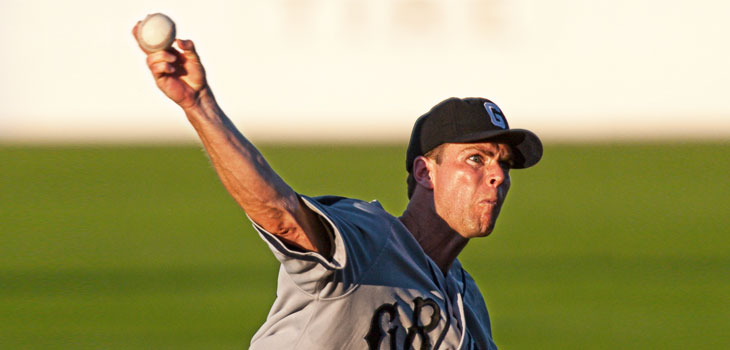
The sports medicine company Motus Global has designed a wearable sensor that is designed to reduce the risk of a major league baseball player straining the ulna collateral ligament (UCL) in his arm.
Body Sensors Measure Ball Player Risk
1 min read Premium comments
Secondary
The sensor resembles a sleeve. According to the company’s description, it is worn on the pitcher’s elbow and it contains a 3D motion sensor that gathers data on arm speed and pitch counts. Trainers and managers use the data collected by a Smartphone app to detect body changes such as UCL deterioration and other changes in pitchers’ and batters’ performance.
The company says that by analyzing the data, trainers and managers can spot signs of strain earlier and take appropriate action before it results in an injury that sidelines players.
Joshua Dines, M.D., a member of the Sports Medicine and Shoulder Service at the Hospital for Special Surgery, an assistant team physician for the Mets and Long Island Ducks, and a consultant for the New York Rangers, and the LA Dodgers, said, “With children playing sports at an earlier age and on a year-round schedule, we are seeing an epidemic of overuse injuries and having to do surgeries at a progressively younger age. We’re not going to change the sports culture, so anything that can change the damage should be aggressively supported.”
Motus Global officials report that they are expanding the technology for specialized needs in other sports such as tennis, football, basketball, and golf. This fall the company tested the wearable with nine major league baseball teams. It plans to develop a consumer version of the sleeve for launching in 2015.
Author
React:
Discussion
This is a fascinating development. In my practice we've seen similar outcomes with the revised protocol. The key differentiator seems to be patient selection criteria. Has anyone else noticed the correlation with BMI thresholds?
Great point. I'd push back slightly on the conclusion, the sample size in the cited study is too small to draw population-level inferences. That said, the directional signal is compelling and worth a larger RCT.
We implemented a similar approach last year. Early results are promising but we're still gathering 12-month follow-up data. Happy to share our protocol if anyone is interested.
Join the conversation
Orthopedic professionals are discussing this. Sign in and upgrade to read every comment and add your voice.