
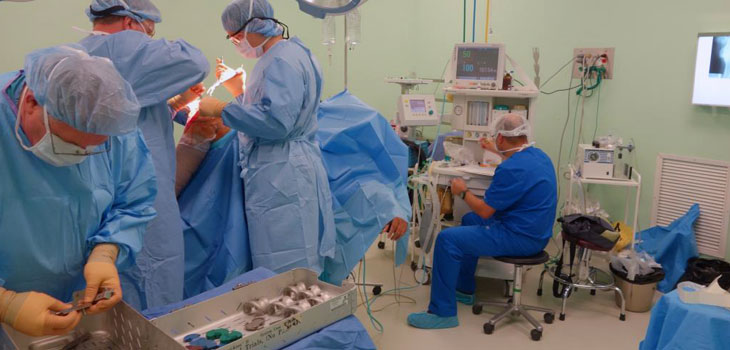
The program is called “Operation Walk Utah.” The organization is a not-for-profit, volunteer medical service that is a chapter of the national Operation Walk. Utah members recently returned from their seventh medical mission to El Salvador where they provided no-cost total hip and knee replacements to patients who needed them the most.
Utah Orthopedic Charity Aids Salvadorans
1 min read Premium comments
Secondary
A team of 39 medical volunteers, including orthopedic surgeons, nurses, physical therapists and administrative assistants arrived in El Salvador on October 24, 2014. When they left on October 31, 2014, 63 Salvadoran citizens had received new hips and knees. Zimmer, Inc. of Warsaw, Indiana, and Total Joint Orthopedics of Salt Lake City, Utah, donated the implants. The expenses of treatment, travel, hospital care, and surgery were covered by contributions from donors and members of the medical staff themselves.
Aaron Hofmann, M.D., board-certified orthopedic surgeon, is the founder of Operation Walk Utah. Director of the Center for Precision Joint Replacement at Salt Lake Regional Medical Center and Hofmann Arthritis Institute, Aaron Hoffman has led the Utah volunteer medical team since 2007.
“The Operation Walk Utah team’s primary focus is to improve the quality of life in all of our patients, ” said Hofmann. “Each year, our team meets extraordinarily brave people who have struggled with serious degenerative diseases for a very long time. It is our duty as medical professionals to provide assistance to the people who need it most. This year, our team was fortunate enough to receive special visits from a few of our patients from last year’s mission. The amount of improvement in their overall health is outstanding and serves as motivation to continue our work year after year.”
Author
React:
Discussion
This is a fascinating development. In my practice we've seen similar outcomes with the revised protocol. The key differentiator seems to be patient selection criteria. Has anyone else noticed the correlation with BMI thresholds?
Great point. I'd push back slightly on the conclusion, the sample size in the cited study is too small to draw population-level inferences. That said, the directional signal is compelling and worth a larger RCT.
We implemented a similar approach last year. Early results are promising but we're still gathering 12-month follow-up data. Happy to share our protocol if anyone is interested.
Join the conversation
Orthopedic professionals are discussing this. Sign in and upgrade to read every comment and add your voice.