
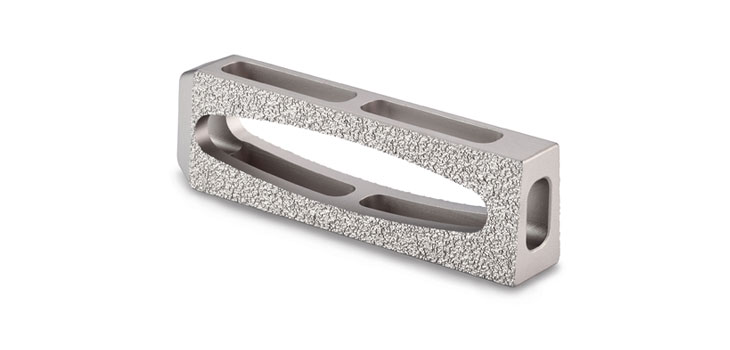
Titan Spine, LLC recently announced that it has received 510(k) clearance from the FDA to market its Endoskeleton line of interbody fusion implants featuring its next generation nanoLOCK surface technology. This advance makes the company’s line of Endoskeleton spinal implants the first FDA-approved interbody fusion that features nanotechnology.
Titan Spine Obtains Clearance for New Surface Technology
2 min read Premium comments
Secondary
Barbara Boyan, Ph.D., Dean of the School of Engineering at Virginia Commonwealth University and an investigator in various Titan Spine studies, said in the November 11, 2014 news release, “This new surface technology further enhances Titan’s current surface and is the result of extensive research in how to create a significantly greater amount of nano-scaled textures that we have shown to be important for the osteogenic response necessary for fusion. The nanoLOCK surface topography is far different than what is found on titanium-coated PEEK implants. In addition, the nanoLOCK surface is not created by applying a coating, but rather is formed by a reductive process of the titanium itself. This eliminates the potential for delamination, which is a concern for products with a PEEK-titanium interface. My team is proud to collaborate with Titan Spine to help develop such a differentiated technology that is truly designed to benefit both patients and surgeons.”
The news release indicates that the product “features Titan’s nanoLOCK manufacturing process, and creates additional textures at the nano level. However, there are no changes to the device indications for use, design, dimensions, or materials. Additionally, mechanical testing demonstrated that the strength of the company’s line of Endoskeleton implants are unaffected by the new surface treatment.”
Peter Ullrich, M.D., former spine surgeon and Chief Executive Officer of Titan Spine, remarked, “Receiving FDA approval for our next-generation surface technology is a tremendous milestone for Titan Spine. This marks the first clearance of nanotechnology interbody devices by the FDA, which is an acknowledgement to Titan’s leadership in developing nanotechnology for the spine and potentially other orthopedic applications. We will continue to innovate the spinal interbody market through close collaboration with leading academic pioneers in material science and biomedical engineering and look forward to future enhancements to our Endoskeleton® devices.”
“The full line of Endoskeletondevices will feature Titan Spine’s proprietary nanoLOCK implant surface technology, consisting of a unique combination of roughened topographies at the macro, micro, and nano levels. This unique combination of surface topographies is designed to create an optimal host-bone response and actively participate in the fusion process by promoting new bone growth, encouraging natural production of bone morphogenetic proteins (BMPs) and creating the potential for a faster and more robust fusion.”
Asked about the development process, Paul Slosar, M.D., Chief Medical Officer of Titan Spine, told OTW, “The most compelling aspect of the development process was when the scientific research team concluded how much better the nanoLOCK surface performed head to head against PEEK and smooth titanium in vitro. This data was so significant that it won the award from SRS/IMAST [Scoliosis Research Society/International Meeting on Advanced Spine Techniques] for the Best Basic Science paper. We worked diligently with our materials science partners to develop a nano-scaled surface that upregulates the osteogenic and angiogenic factors necessary for fusion. As a result, our surgeons and their patients can be assured that we have scientifically engineered this surface for optimal performance.”
Author
React:
Discussion
This is a fascinating development. In my practice we've seen similar outcomes with the revised protocol. The key differentiator seems to be patient selection criteria. Has anyone else noticed the correlation with BMI thresholds?
Great point. I'd push back slightly on the conclusion, the sample size in the cited study is too small to draw population-level inferences. That said, the directional signal is compelling and worth a larger RCT.
We implemented a similar approach last year. Early results are promising but we're still gathering 12-month follow-up data. Happy to share our protocol if anyone is interested.
Join the conversation
Orthopedic professionals are discussing this. Sign in and upgrade to read every comment and add your voice.