
After nine months of aching knees, shoulders, arms and legs, Diane Velluci was at her wit’s end. Then she went to Hospital for Special Surgery (HSS).
Metal Allergy Saga Resolved at HSS
2 min read Premium comments
Secondary
What began as a double knee replacement at a Philadelphia hospital ended in extreme pain and weakness. Velluci says that her original orthopedic surgeon refused to take her complaints seriously, and that she attempted to see other orthopedic surgeons, but none would see her prior to a year in the future.
“I thought, ‘why is this happening to me?’ I’m not a bad person, ” she said in the December 15, 2014 news release. “I was always respectful; I was never rude. I thought, ‘Why won’t they help me?’ I was being turned away by almost everyone; it was so hurtful.”
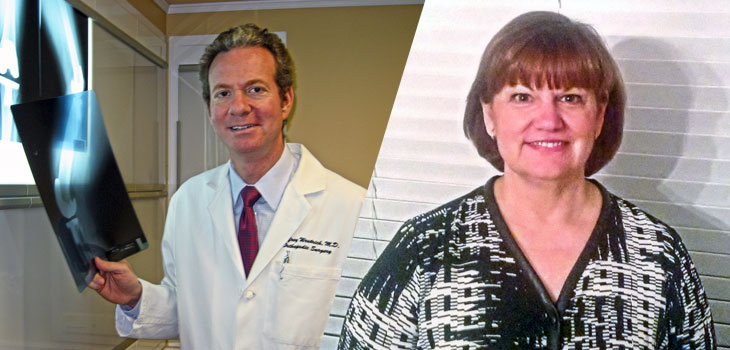
At last she was referred to Geoffrey Westrich, M.D. at HSS.
“He gave me my life back, ” Velluci said.
“It turned out she was allergic to the metal in the knee implants, and this was causing the severe symptoms throughout her body, ” said Dr. Westrich, director of research, Adult Reconstruction and Joint Replacement at Hospital for Special Surgery, in the news release.
“It all happened very fast, ” she recalls. “I went to the Hospital for Special Surgery for the consultation with Dr. Westrich and soon after had the first revision surgery. I’m so thankful he listened to me. He cared, he was compassionate. He would not give me any guarantees, but I was so grateful someone was trying to help me.”
The first revision surgery on her left knee took place in January 2014. After the surgery, week by week, her pain diminished. In May, she had the second revision surgery. By July, she says her pain was almost gone. She says she is now doing well, has regained the use of her arms, can run errands and walk through a shopping mall. She can once again visit her mother who lives in a nursing home.
“It’s incredible that such severe symptoms could resolve so rapidly once we replaced the metal implants, ” Dr. Westrich said. “It’s important for any patient who has a problem after joint replacement to see their doctor and insist on being taken seriously, ” he added. “There is sometimes a tendency in medicine to miss or dismiss something we don’t see frequently, and that makes it all the more important for patients to insist they get the care they need.”
“If the doctor dismisses the patient’s concerns, the individual should find another physician, preferably at a joint replacement center that does many, many procedures and is used to dealing with complications, ” he says. “And it is truly best to have the surgery done in such a joint replacement center in the first place for the best chance of a good outcome.”
Dr. Westrich told OTW, “It is best to simply ask all patients if they have any allergies, especially to costume jewelry. If they say they do, then is it best practice to consider an implant without nickel or cobalt chromium for their surgery to avoid any potential issues.”
Author
React:
Discussion
This is a fascinating development. In my practice we've seen similar outcomes with the revised protocol. The key differentiator seems to be patient selection criteria. Has anyone else noticed the correlation with BMI thresholds?
Great point. I'd push back slightly on the conclusion, the sample size in the cited study is too small to draw population-level inferences. That said, the directional signal is compelling and worth a larger RCT.
We implemented a similar approach last year. Early results are promising but we're still gathering 12-month follow-up data. Happy to share our protocol if anyone is interested.
Join the conversation
Orthopedic professionals are discussing this. Sign in and upgrade to read every comment and add your voice.