
According to a study presented at the recent Radiological Society of North America (RSNA), it’s possible that surgery to repair meniscal tears may increase the risk of osteoarthritis (OA) and cartilage loss in some patients. The researchers used data from the Osteoarthritis Initiative, an ongoing observational study of knee OA incidence and progression.
Meniscal Surgery Increasing Risk of OA, Cartilage Loss?
2 min read Premium comments
Secondary
“Meniscal surgery is one of the most common orthopedic procedures performed to alleviate pain and improve joint function, ” said Frank W. Roemer, M.D., from Boston University School of Medicine in Boston and the University of Erlangen-Nuremberg in Erlangen, Germany, in the December 3, 2014 news release. “However, increasing evidence is emerging that suggests meniscal surgery may be detrimental to the knee joint.”
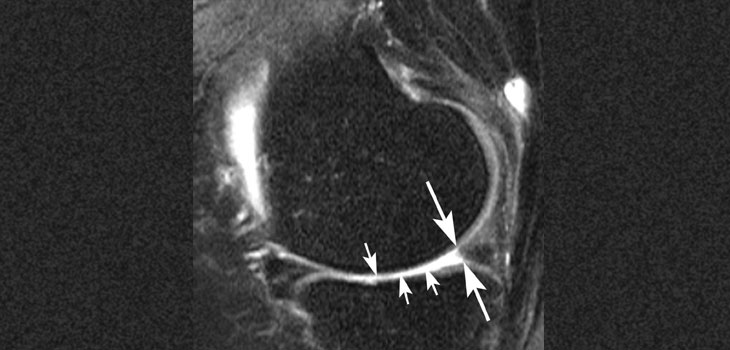
As indicated in the news release, “Patients in the study were on average 60.2 years old and predominantly overweight, with a mean body mass index (BMI) of 28.3. Approximately two-thirds of the patients were women. The researchers studied magnetic resonance imaging (MRI) exams of 355 knees that developed osteoarthritis during a five-year period, and a control group that was matched for age, gender, arthritic severity in both knees and BMI. Of all knees, 31 underwent meniscal surgery during the year prior to the arthritis diagnosis, and 280 knees had signs of meniscal damage on MRI but did not have surgery. There was also a group of control cases that had no meniscal damage. The researchers assessed the risk of developing arthritis and cartilage loss during the following year for the different groups.”
“We found that patients without knee osteoarthritis who underwent meniscal surgery had a highly increased risk for developing osteoarthritis and cartilage loss in the following year compared to those that did not have surgery, regardless of presence or absence of a meniscal tear in the year before, ” Dr. Roemer said in the news release.
“All 31 of the knees that underwent meniscal surgery during the prior year developed osteoarthritis, compared with 165 (59%) of the knees with meniscal damage that didn’t have surgery. In addition, cartilage loss was much more common among knees that had undergone surgery: 80.8% of knees with surgery showed cartilage loss, compared with 39.5% of knees with meniscal damage and no surgery.”
“The indications for meniscal surgery might need to be discussed more carefully in order to avoid accelerated knee joint degeneration, ” Dr. Roemer said.
React:
Discussion
This is a fascinating development. In my practice we've seen similar outcomes with the revised protocol. The key differentiator seems to be patient selection criteria. Has anyone else noticed the correlation with BMI thresholds?
Great point. I'd push back slightly on the conclusion, the sample size in the cited study is too small to draw population-level inferences. That said, the directional signal is compelling and worth a larger RCT.
We implemented a similar approach last year. Early results are promising but we're still gathering 12-month follow-up data. Happy to share our protocol if anyone is interested.
Join the conversation
Orthopedic professionals are discussing this. Sign in and upgrade to read every comment and add your voice.