
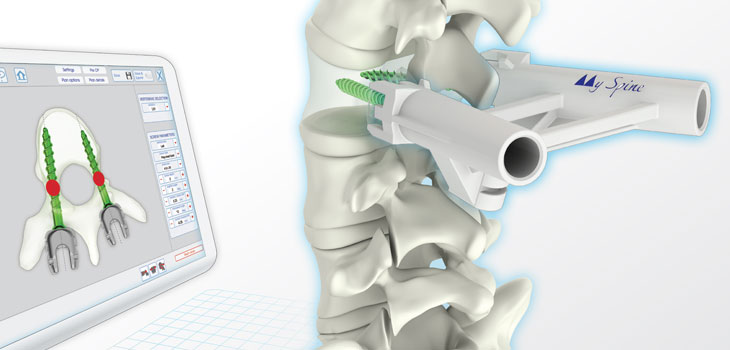
Medacta USA, the American subsidiary of Medacta International, SA, has completed its first surgery in the U.S. utilizing its product MySpine Patient-Matched Technology. The system utilizes 3-D reconstruction and 3-D printing technologies to produce patient specific surgical guides to support spinal surgeons in complex deformity cases.
Medacta Completes First MySpine Surgeries in U.S.
1 min read Premium comments
Secondary
According to company officials, MySpine is designed to help surgeons identify pedicle entry points, screw trajectories, and implant specifications. The system received 510(k) clearance from the U.S. Food and Drug Administration in May 2014 and officials state it is the first product available in the U.S. able to produce patient-specific guides for the spine vertebrae. To do this MySpine makes use of CT scan algorithms and 3-D medical printing technology.
Samuel S. Jorgenson, M.D. and Richard Manos, M.D. of the Spine Institute of Idaho, performed the first two surgeries with MySpine. Jorgenson said of the surgery, “The MySpine customized placement guides offer a welcome new approach to dealing with the nuances and complexities of a patient’s spinal anatomy.” Manos added: “The customized pre-operative process provides a high level of precision and accuracy. This cuts down on the overall time of the procedure, and will help us deliver more efficient care to the multiple patients we see each day with challenging spinal cases.”
The MySpine clinical experience is detailed in a study published in the Journal of Spinal Disorders and Techniques, which tracked results from four patients with severe scoliosis whose navigational templates and placement guides were manufactured using MySpine’s CT-based 3-D models. In addition, Orthopedics This Week recognized MySpine as a best New Technology for Spine Care in 2014, an award that honors exemplary and innovative spine surgery products.
Author
React:
Discussion
This is a fascinating development. In my practice we've seen similar outcomes with the revised protocol. The key differentiator seems to be patient selection criteria. Has anyone else noticed the correlation with BMI thresholds?
Great point. I'd push back slightly on the conclusion, the sample size in the cited study is too small to draw population-level inferences. That said, the directional signal is compelling and worth a larger RCT.
We implemented a similar approach last year. Early results are promising but we're still gathering 12-month follow-up data. Happy to share our protocol if anyone is interested.
Join the conversation
Orthopedic professionals are discussing this. Sign in and upgrade to read every comment and add your voice.