
DePuy Synthes Spine has a new device to help kids suffering from thoracic insufficiency syndrome (TIS) take a deep breath.
Kids With TIS (Scoliosis) Have Newly Cleared Device to Breathe Easier
2 min read Premium comments
Secondary
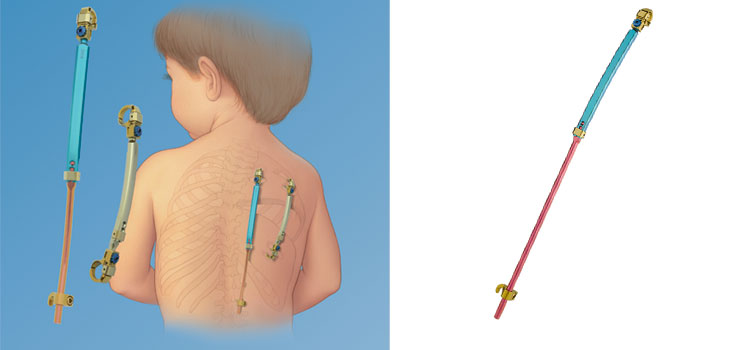
Kids with TIS experience impaired breathing or lung growth. As they grow, the spine and rib cage do not keep pace, resulting in chest wall deformities and sometimes requiring oxygen or ventilator support. The most common treatment is a VEPTR (vertical expandable prosthetic titanium rib) device. The device is a vertical titanium rib that is implanted between the ribs to keep the chest wall expanded. The device helps the spine grow straighter and supports lung growth and natural breathing and can be expanded and adjusted as a child grows.
FDA Clearance of VEPTR/VEPTR II
On December 4, 2014, the company announced the FDA 510(k) clearance of its VEPTR/VEPTR II Vertical Expandable Prosthetic Titanium Rib Devices. Company President Max Reinhardt said the devices “fill a critical need and offers hope for a brighter future for many children.”
According to the company, the devices “include a system of curved titanium rods that are surgically attached to the ribs, spine or pelvis to stabilize and straighten the spine, and to create a separation between ribs to potentially improve breathing and enable normal lung growth and development.” After the initial procedure, the devices are lengthened as a child grows using minimally invasive techniques.
Potential Benefits
Potential benefits of treatment with the devices “include more normal growth patterns without spinal growth limitations, decreased deformity of the spine, more room for the lungs to grow, increased amount of daily activities because of the increased amount of space for air in the lungs and a decreased need for using ventilators.”
The company hopes the FDA clearance will improve access to the treatment which has only been available since 2004 under Humanitarian Device Exemption regulations. The devices, says the company, are the first spine devices to have such a change in regulatory status. “The 510(k) clearance is a great advancement, enabling the VEPTR/VETPR II Devices to now be used at the discretion of the surgeon for spine and chest wall deformities associated with TIS, ” said Robert M. Campbell, Jr., M.D., Director of the Center for Thoracic Insufficiency Syndrome at The Children’s Hospital of Philadelphia, an inventor of VEPTR/VEPTR II Devices and the first to identify TIS as a disease condition that requires specialized care and treatment. “This will likely increase the availability of the VEPTR Technology for many institutions.”
Some kids and their parents may now breathe easier.
Author
React:
Discussion
This is a fascinating development. In my practice we've seen similar outcomes with the revised protocol. The key differentiator seems to be patient selection criteria. Has anyone else noticed the correlation with BMI thresholds?
Great point. I'd push back slightly on the conclusion, the sample size in the cited study is too small to draw population-level inferences. That said, the directional signal is compelling and worth a larger RCT.
We implemented a similar approach last year. Early results are promising but we're still gathering 12-month follow-up data. Happy to share our protocol if anyone is interested.
Join the conversation
Orthopedic professionals are discussing this. Sign in and upgrade to read every comment and add your voice.