
“OK, so you have a bloodless field using a tourniquet in TKA, ” says Dickey Jones. “But there are many downsides, such as nerve damage and a delay in the recovery of muscle function.” Steve MacDonald counters, “There is no clinical evidence of nerve damage or delays in muscle function recovery. And several studies show decreased overall blood loss.”
Jones v. MacDonald Over Tourniquetless TKA
7 min read Premium comments
Great Debates
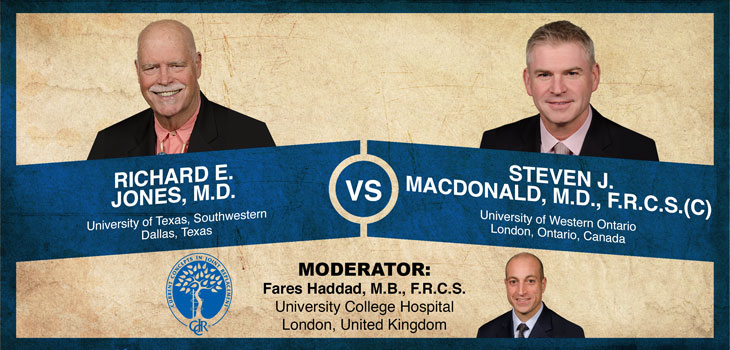
This week’s Orthopaedic Crossfire® debate was part of a landmark event, the first Brazilian CCJR meeting. The event, which took place in September 2014, was held in Iguassu Falls. This week’s Orthopaedic Crossfire® debate is “Tourniquetless TKA: Let It Bleed.” For the proposition was Richard E. Jones, M.D. of the University of Texas, Southwestern. Against the proposition was Steven J. MacDonald, M.D., F.R.C.S.(C) from the University of Western Ontario. Moderating is Fares Haddad, M.B., F.R.C.S. of the University College Hospital in London, United Kingdom.
Dr. Jones: “What’s the benefit of doing a total knee arthroplasty (TKA) with a tourniquet? You have a bloodless field…and there is potentially a better bone cement implant interface for fixation. The downsides—and it’s a long list—are direct (secondary to pressure); indirect (secondary to hypoxia). And there is a delay in recovery of muscle function…vascular problems, altered hemodynamics. When you exsanguinate a limb, you get a 20% increase in circulatory volume. Some patients’ hearts may not be ready for that. And there is reactive hyperaemia when you release the tourniquet as well as a 10% increase in limb size that increases soft tissue tension and secondary pain.”
“There is a higher risk of vascular injury, particularly in artherosclerotic or calcified arteries. There is increased risk of DVT with trauma to the vessel walls; also, increased levels of thrombin/antithrombin complexes, which leads to 5.3x more risk for large venus emboli propagation (per a transesophageal echo). There is also a high percentage of wound leakage.”
“In our early experience, we had high risk patients who had previous DVT or pulmonary embolism, multiple scarring and compromised cardiovascular structure. But for the last 20 years we have used no tourniquet on any primary or revision total knee.”
“A 2009 survey by the American Association of Hip and Knee Surgeons (AAHKS) found that 37% always use a tourniquet, 58% always use a tourniquet except if there is a vascular concern; only 5% of the entire AAHKS population use a tourniquet and then put it up during cementation.”
“Our operative protocol: regional anesthesia because it helps control blood pressure and reduce bleeding. The incision and approach is made with the knee in 90 degrees of flexion. We do meticulous hemostasis on the way in, and all vessels are readily seen and coagulated (we use an argon beam coagulator). We use ropivacaine with epinephrine periarticularly, coagulating the posterior tissues during flexion/tension balancing; we also do saline jet lavage. Then we deliver filtered carbon dioxide through a CarboJet system to dry and prepare the bone beds. We then use three grams of tranexamic acid and 100cc’s of saline topically administered. We do routine closure and a bulky, compressive Robert Jones-type knee dressing. Increased cement penetration counters bone resorption over time. And since bone into which cement is interdigitated initially resorbs steadily with time and service, maximal interdigitation is important.”
“We found no differences in blood loss or transfusion rate and less postop pain. They had faster straight leg raise and better knee flexion gains. There were fewer wound healing disturbances and the cement penetration was equivalent.”
“We always go along the medial border of the patella use an argon beam coagulator, which we use as a regular bovie. Same thing with the coag part of this argon beam coagulator…we use a midvastus approach. And we use only rotating platforms.”
Dr. MacDonald: “I am opposed to the premise that I’m going to perform a TKA without a tourniquet. I have done TKA without a tourniquet in a select few patients, i.e., the vasculopaths with no distal pulses and non complaining patients in the cadaver lab. There are few randomized clinical trials to guide us, and there is no registry data, and there are many opinion pieces. So why use a tourniquet? Blood loss.”
“In a meta-analysis of 15 papers with 1, 000 total knees there was significantly greater intraoperative blood loss without a tourniquet. What’s curious is that overall blood loss—intraoperative and postop—was not different whether or not you use a tourniquet.”
“Several studies show decreased blood loss overall. In a randomized clinical trial (RCT) with 72 patients the tourniquet group had lower overall blood loss, but had slightly more postoperative pain. We all appreciate that some patients do get thigh pain after a tourniquet is used.”
“Another RCT looks at using a tourniquet just for cementing or using it for the entire procedure. They were going to do over 200 cases, but they stopped at 65 because of the higher risk of transfusion if you’re only using it for part of the procedure. There were no differences in any other outcome measure. You want a dry bone surface for cementing; if you don’t have that the theoretical risk is late loosening. But note that the majority of TKAs performed historically worldwide have been done with a tourniquet, so I don’t think we can simply say that you can’t get loosening if you don’t use a tourniquet.”
“There are alternatives. I use pulsatile lavage with a tourniquet, but there are different ways to get a dry bone surface. But they all come with a cost in terms of dollars and time. In a series of 3, 500 total knees they found a direct correlation between OR time and infection. So if you’re going to use an alternative make sure that you’re not all of a sudden adding five or ten minutes to the procedure time.”
“The stated downsides to a tourniquet are either basic science theories, rare, or short term. Vessel wall damage leading to increased DVT. There’s not a single clinical paper out there that supports this. In one tourniquet versus no tourniquet study all patients underwent ultrasounds pre- and post-op to determine if there was any increase in thrombosis—there was not. There is no clinical evidence for an increase in wound healing disturbances or delay in muscle function; nerve damage is rare.”
“Don’t use a tourniquet if you’re concerned about the theoretical risks and you have alternates to achieving a dry field and your alternate ways don’t increase OR time. If you’re highly intelligent then you should use a tourniquet.”
Moderator Haddad: “Do you ever think while doing a TKA, ‘I wish I could inflate the tourniquet now.’”
Dr. Jones: “I say that we always put the tourniquet on, but we never put it up. The reason there ended up being more initial blood loss in those patients who just had the tourniquet up briefly was because of the reactive hyperemia from letting the tourniquet down. That was a flawed study.”
Moderator Haddad: “Steve, some people argue that even putting a tourniquet on adds time before the operation that’s not intraoperative time. Then, people are deflating it to get hemostasis at the end. Is that your practice?”
Dr. MacDonald: “I keep the tourniquet on until the dressing goes on. If you’re going to use it you should do so for the entire procedure.”
Dr. Jones: “I agree. Use it all the way and don’t let it down. And get a good compressive and obdurating dressing on there.”
Moderator Haddad: “What kind of pressure should we be putting it on?”
Dr. MacDonald: “I put it up to 300 for every patient; for a morbidly obese leg I put it to 350. There is some evidence that you could do it 100 points above their mean systolic pressure. Do you use a tourniquet for your knees?”
Moderator Haddad: “We use it just for cementing and it’s based on blood pressure.”
Dr. MacDonald: “We don’t know which is right, but there are two theoretical ways to go. Same number or modified depending on the patient’s blood pressure.”
Dr. Jones: “Let’s say you do it at 350, Steve. Do you ever have an occasion where you have to raise it another 100 because you’re getting a lot of leak? The fatter the patient is the more difficult it is to get the tourniquet up without leaking.”
Dr. MacDonald: “When the tourniquet leaks like that I say to my residents and fellows, ‘This is why you use a tourniquet.’ But you can’t keep putting it higher and higher. If you are getting it leaking through then I will deflate the tourniquet and just cope with the regular bleeding.”
Moderator Haddad: “Many of your patients have a pretty high body mass index and it can be tough to get a decent tourniquet on. What about access? In your revisions, do you sometimes feel that the tourniquet is restricting you from getting as high as you need to?”
Dr. MacDonald: “If you’re doing a tumor type prosthesis I would use a sterile tourniquet so that it goes on in the operative field so you can pop it off it you have to go higher to get access to the distal femur.”
Moderator Haddad: “Dickey, Steve said that it takes you a long time to do the CarboJjet lavage.”
Dr. Jones: “With my team I was out of the OR about 30 minutes faster than all of my partners when they were using a tourniquet. That’s terrible data.”
Dr. MacDonald: “Your partners must be slow. What are they doing?”
Moderator Haddad: “Steve, what do you think is the minimum clinically significant time difference between a standard operation and an operation that increases your infection risk?”
Dr. MacDonald: “We don’t know. I think it’s a continuous variable and it’s multifactorial…and probably somewhat patient specific. Is five minutes a difference? Probably not.”
Dr. Jones: “When that two hours turns into two hours and five minutes, then two hours and fifteen minutes, then you’re starting to worry a bit. The standard for leaving a tourniquet up in North America is two hours.”
Moderator Haddad: “Thank you, gentlemen.”
Please visit www.CCJR.com to register for the 2014 CCJR Winter Meeting, December 10 – 13 in Orlando.
React:
Discussion
This is a fascinating development. In my practice we've seen similar outcomes with the revised protocol. The key differentiator seems to be patient selection criteria. Has anyone else noticed the correlation with BMI thresholds?
Great point. I'd push back slightly on the conclusion, the sample size in the cited study is too small to draw population-level inferences. That said, the directional signal is compelling and worth a larger RCT.
We implemented a similar approach last year. Early results are promising but we're still gathering 12-month follow-up data. Happy to share our protocol if anyone is interested.
Join the conversation
Orthopedic professionals are discussing this. Sign in and upgrade to read every comment and add your voice.