
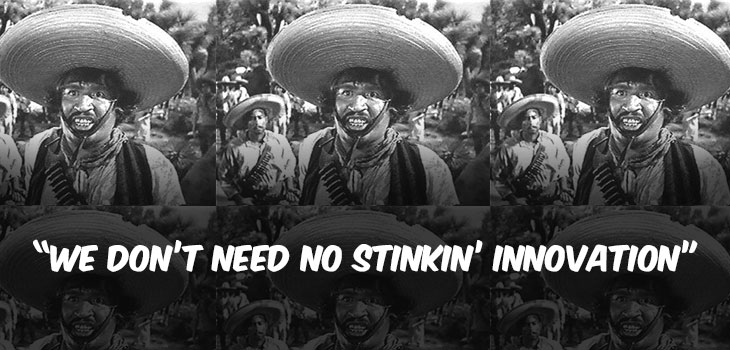
“We don’t need no stinkin’ innovation, we need more imitation.”
“Imitation, Not Innovation” Urges Harvard Business Review Article
3 min read Premium comments
Secondary
That’s the message from two healthcare leaders in a November 19, 2014 Harvard Business Review article who say providers should focus on existing approaches that actually work and should actively seek out good ideas that have been tried and refined, bring those ideas home, and adapt them for local use.
Roth and Lee: International Institute for Imitation
Anna Roth, CEO of Contra Costa Medical Center (CCRMC) and Thomas H. Lee, M.D., chief medical officer at Press Ganey Associates, somewhat tongue in cheek, propose a new International Institute for Imitation, which would provide easily accessible information for healthcare professionals who want to improve their organizations with the help of proven methods. Roth and Lee want to start an annual prize for the “highest impact implementation” of an idea created by someone else, and encourage embracing imitation for the good of bettering healthcare organizations across the world.
They credit Jon Pryor, the CEO of Minnesota’s Hennepin County Medical Center, who they say mused about appointing a Chief Imitation Officer for his organization – “someone whose sole job was to look outside for good ideas to bring home. After all, an idea that has already worked somewhere else is more likely to be effective than one that is completely new and untried.”
Roth and Lee offer two examples of effective imitation.
Thedacare’s “Visibility Wall”
First, in 2013, a team from (CCRMC) visited the Thedacare Health System. “Inspired by their systems for making organizational performance transparent, Contra Costa took their idea of a ‘visibility wall’ and created its own. The wall, located in a high-utilization meeting space, exhibits reports of improvement initiatives and their performance, from improving patient wait times and satisfaction to reductions in the rate of sepsis mortality and increases in ‘lives saved.’ The wall plays a crucial role in sharing goals and improvements underway, and inspires productive conversations about our progress and where we need to do better. It is also helping drive a culture of transparency, where sharing performance data is a way of life.”
Utah’s On-Line Transparency Program
Second, they offer an example from the University of Utah’s Health System that shows how imitation can speed the implementation of an innovation. Utah developed an on-line transparency program with patient comments over four years (2009 to 2013); for the first three years, the comments were only visible to Utah clinicians and staff. “In 2013, Utah made the unedited comments available in full to the public. The result has been improved clinical performance across a range of measures. Piedmont Health System in Georgia heard about this innovation in November 2013, decided to go forward in December 2013, and went live in April 2014. Piedmont skipped the ‘internal transparency’ phase that Utah had gone through, and cut right to the full transparency phase, because leadership knew that the program worked.”
Facing Same Challenges
“We know what you’re thinking, ” write the authors. “Health care is too complex, too specialized, too local to pursue such a systematic emphasis on imitation. To that, we say providers are not as different from each other as they think. In fact, we draw great comfort from seeing how similar health care providers everywhere really are. All providers face the same timeless challenge of relieving our patients’ suffering, and we all get great satisfaction when we make a dent in their problems, with efficiency and reliability.”
Borrow From Other Industries
The new institute they envision would support taking ideas from other industries as well. For example, they say health care systems have been using the Toyota production system to improve quality and efficiency for decades now. Other examples include adopting methods from the military and aviation safety, such as checklists.
Another example is how Proctor and Gamble has honed its ability to conduct well-organized global searches for new products and solutions, pulling them into their system and then refining them. Roth and Lee urge providers to tap in and partner up with organizations that have expertise in delivering social support services that affect patient health, like access to food, housing and employment.
Be a “Fast Follower”
Finally, they urge providers to leverage the benefits of being a “fast follower.” “Let’s look to the health systems that are outperforming their peers and imitate them. Let’s lower risk and investment in the unknown or unproven. Let’s lionize the imitator. It’s the faster way to get better.”
Author
React:
Discussion
This is a fascinating development. In my practice we've seen similar outcomes with the revised protocol. The key differentiator seems to be patient selection criteria. Has anyone else noticed the correlation with BMI thresholds?
Great point. I'd push back slightly on the conclusion, the sample size in the cited study is too small to draw population-level inferences. That said, the directional signal is compelling and worth a larger RCT.
We implemented a similar approach last year. Early results are promising but we're still gathering 12-month follow-up data. Happy to share our protocol if anyone is interested.
Join the conversation
Orthopedic professionals are discussing this. Sign in and upgrade to read every comment and add your voice.