
Regenerative cartilage company, Histogenics Corporation, announced the offering of 5.9 million common shares at $11 per share for its initial public offering (IPO). The net offering proceeds from the sale of the shares are expected to be approximately $57.2 million
Histogenics Is Public – Regenerating Cartilage
2 min read Premium comments
Secondary
“HSGX”
The company shares began trading on the NASDAQ Global Market under the ticker symbol “HSGX” on December 3, 2014, with a market cap of around $140 million.
According to a December 2, 2014 company announcement, Histogenics’ regenerative medicine platform “combines expertise in cell processing, scaffolding, tissue engineering, bioadhesives and growth factors to provide solutions that can be utilized individually or in concert to treat musculoskeletal-related conditions.” The company’s first product candidate, NeoCart, is being investigated in a Phase 3 clinical trial.
If the clinical trial is successful, the company says the data may be used to support efficacy claims for NeoCart approval and demonstrate clinical superiority over the current standard of care, microfracture.
Using Patient’s Own Cells
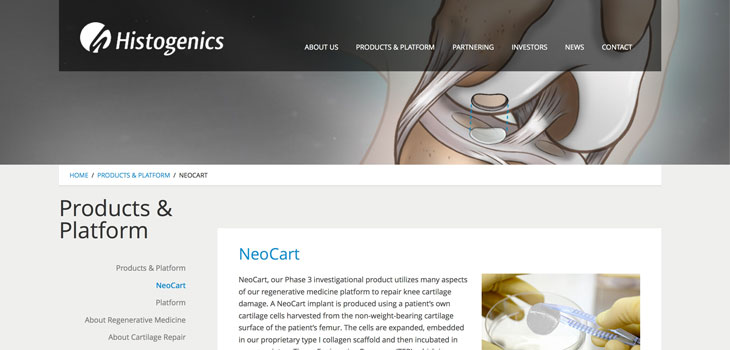
NeoCart, according to the company, uses a platform to develop an “innovative tissue implant” intended to treat tissue injury in the field of orthopedics, specifically cartilage damage in the knee. The product is a “cartilage-like implant” created using a patient’s own cartilage cells through a series of tissue engineering processes.
“First, the patient’s cells are separated from a tissue biopsy specimen extracted from the patient by a surgeon and multiplied in our laboratory.
“The cells are then infused into our proprietary scaffold that provides structure for the developing implant. Before NeoCart is implanted in a patient, the cell- and scaffold construct undergoes a bioengineering process in our Tissue Engineering Processor (TEP). Our TEP is designed to mimic the conditions found in a joint so that the implant is prepared to begin functioning like normal healthy cartilage prior to implantation.
“When NeoCart is implanted, a bioadhesive is used to anchor NeoCart in the cartilage injury and seal the implant to the surrounding native cartilage interface. The use of the bioadhesive eliminates the need for complicated suturing. We believe that the Phase 1 and Phase 2 clinical trials provide preliminary evidence for the safety of the NeoCart implant and improvement in pain and function in patients treated with NeoCart.”
Intended Use of Funds
The company’s prospectus says it intends to use the net proceeds of the offering as follows:
- $16.0 million to fund, develop and advance NeoCart through the currently enrolling Phase 3 clinical trial;
- $2.9 million for development work associated with the company’s Exclusive Channel Collaboration Agreement with Intrexon Corporation;
- $5.1 million to build out the company’s manufacturing capabilities and develop potential process improvements in making NeoCart; and
- The remainder for general and administrative expenses (including personnel-related costs), potential future development programs, early-stage research and development, capital expenditures and working capital and other general corporate purposes.
The company was founded in 2000 in Waltham, Massachusetts.
Author
React:
Discussion
This is a fascinating development. In my practice we've seen similar outcomes with the revised protocol. The key differentiator seems to be patient selection criteria. Has anyone else noticed the correlation with BMI thresholds?
Great point. I'd push back slightly on the conclusion, the sample size in the cited study is too small to draw population-level inferences. That said, the directional signal is compelling and worth a larger RCT.
We implemented a similar approach last year. Early results are promising but we're still gathering 12-month follow-up data. Happy to share our protocol if anyone is interested.
Join the conversation
Orthopedic professionals are discussing this. Sign in and upgrade to read every comment and add your voice.