
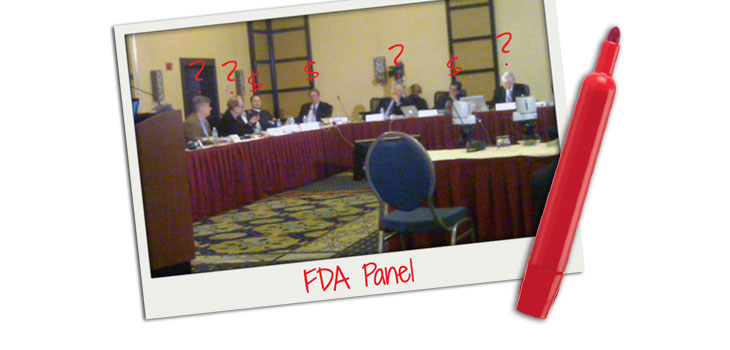
A December 8, 2014 Wall Street Journal article says the FDA is not disclosing enough financial ties between device makers and physicians serving on the FDA’s expert panels.
FDA Panel Expert Links to Industry a Mystery
3 min read Premium comments
Secondary
Panelist Industry Payments
The story cited an analysis of corporate, state and federal data sources which showed that from 2012 to 2014, one-third of 122 panel (including orthopedics) members had received compensation from device companies. Nearly 10% of the expert panel members, claims the article, received “something of value from the specific company whose product they were evaluating.”
The Journal’s tally of payments to members of panels in 2014 found that 64% received no value from device makers in the past five years. The rest did, varying from less than $15 for food and beverage to more than $500, 000 in research funding. Of panelists who received something, 32% got less than $500 in value and 26% received $10, 000 of value or greater.
The FDA only disclosed about 1% of those corporate connections, according to the article. Under current law the agency only discloses panelist financial interests when there is a determination the expert needs a waiver in order to serve.
Conflicts and “502” Authorization
If the FDA decides a payment isn’t a conflict, it issues a “502 authorization” letting the person serve. But the 502 authorizations, unlike waivers, aren’t publicly disclosed. The FDA declined to tell the Journal how many 502 authorizations it issues annually.
The FDA has a lot of discretion when making a determination of a waiver. Having been paid by a device company doesn’t disqualify an expert from sitting on an advisory panel, nor require public disclosure, “as long as the work wasn’t related to the specific topic or product the panel focuses on.”
A typical disqualifying event is if a panelist has current consulting work directly related to a panel topic or owns a large amount of stock in the applicant company’s stock. But if the agency thinks it can’t get the expertise elsewhere, it can issue a waiver. Those waivers are then posted on the FDA website. The agency said it can’t reveal any other financial ties or potential conflicts because what the panelists tell them is confidential.
Brain Drain Fear
The FDA fears that more disclosure requirements could discourage people from sitting on panels.
The Journal story cites the example of Edward Y. Cheng, M.D., an orthopedic surgeon at the University of Minnesota Medical School and Cancer Center. He told the Journal that doctors “have a strong financial disincentive to serve because they must take time away from their practices.”
Dr. Cheng, according to the story, had $6, 666 in consulting fees from an all-metal hip maker a year before he sat on a panel evaluating the safety of that type of hip. Those fees were not disclosed by the FDA and Dr. Cheng said the work was unrelated to all-metal hips.
Foggy Discretion
He noted that it is the FDA’s job to gauge whether a conflict exists but added: “If I personally thought a conflict existed that would affect my ability to remain unbiased, I would decline to participate.” The FDA told the Journal it doesn’t comment on individual panel advisers or their finances.
The story concluded that there is no central way for the public to learn of ties between panel members and devices makers. Celia Wexler, a lobbyist for the Union of Concerned Scientist told the Journal that the problem with the FDA’s policy is “you don’t know how they use their discretion. It’s very difficult for us to know to what extent the FDA probes, and the extent to which panel members take the disclosure requirements seriously.”
Author
React:
Discussion
This is a fascinating development. In my practice we've seen similar outcomes with the revised protocol. The key differentiator seems to be patient selection criteria. Has anyone else noticed the correlation with BMI thresholds?
Great point. I'd push back slightly on the conclusion, the sample size in the cited study is too small to draw population-level inferences. That said, the directional signal is compelling and worth a larger RCT.
We implemented a similar approach last year. Early results are promising but we're still gathering 12-month follow-up data. Happy to share our protocol if anyone is interested.
Join the conversation
Orthopedic professionals are discussing this. Sign in and upgrade to read every comment and add your voice.