
On August 2, 2012, the Centers for Medicare and Medicaid Services (CMS) issued a Medicare National Coverage Determination which allows coverage of autologous PRP (platelet-rich plasma) under coverage with Evidence Development (CED) with certain conditions.
CMS Issues Instructions for PRP Coverage Study
1 min read Premium comments
Secondary
On December 15, 2014, the agency updated its coverage page for meeting the conditions for applying for approval of a CED study.
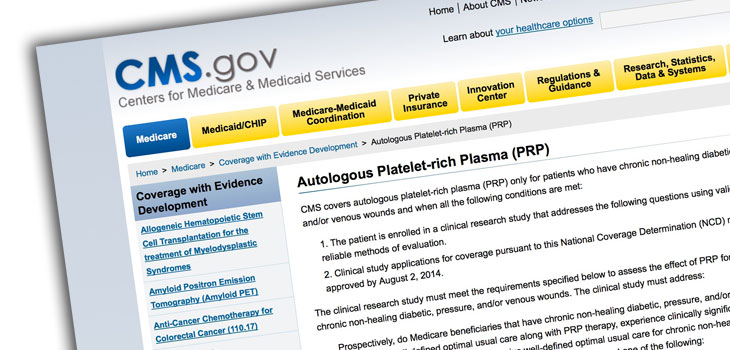
CMS covers autologous PRP only for patients who have chronic non-healing diabetic, pressure, and/or venous wounds and when all the following conditions are met:
- The patient is enrolled in a clinical research study that addresses the following questions using validated and reliable methods of evaluation.
- Clinical study applications for coverage pursuant to this National Coverage Determination (NCD) must be approved by August 2, 2014.
The clinical research study must meet the requirements specified below to assess the effect of PRP for the treatment of chronic non-healing diabetic, pressure, and/or venous wounds. The clinical study must address:
“Prospectively, do Medicare beneficiaries that have chronic non-healing diabetic, pressure, and/or venous wounds who receive well-defined optimal usual care along with PRP therapy, experience clinically significant health outcomes compared to patients who receive well-defined optimal usual care for chronic non-healing diabetic, pressure, and/or venous wounds as indicated by addressing at least one of the following:”
- complete wound healing;
- ability to return to previous function and resumption of normal activities; or
- reduction of wound size or healing trajectory, which results in the patient’s ability to return to previous function and resumption of normal activities?
Author
React:
Discussion
This is a fascinating development. In my practice we've seen similar outcomes with the revised protocol. The key differentiator seems to be patient selection criteria. Has anyone else noticed the correlation with BMI thresholds?
Great point. I'd push back slightly on the conclusion, the sample size in the cited study is too small to draw population-level inferences. That said, the directional signal is compelling and worth a larger RCT.
We implemented a similar approach last year. Early results are promising but we're still gathering 12-month follow-up data. Happy to share our protocol if anyone is interested.
Join the conversation
Orthopedic professionals are discussing this. Sign in and upgrade to read every comment and add your voice.