
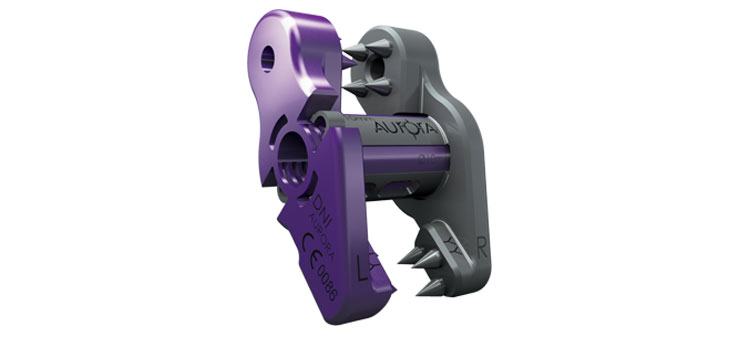
Aurora Spine Corporation has received 510(k) clearance from the U.S. Food and Drug Administration (FDA) for its slimmest minimally invasive interspinous fixation implant for spinal fusion—called the Zip 51.
Aurora Spine’s Zip 51 Gets FDA Clearance
1 min read Premium comments
Secondary
Aurora Spine developed the Zip 51 “as an alternative to pedicle screw fixation, ” say company officials, “and designed it for stabilization and load sharing during TI-S1 thoracolumbar fusion procedures.” The device, they say, “it is also intended to be an adjunct to interbody fusion and the treatment of degenerative disc disease, spondylolisthesis, trauma and/or tumor.”
The Zip 51 represents Aurora Spine’s fifth FDA clearance in 11 months. “Aurora is changing spine surgery and we are thrilled to receive FDA clearance with the ZIP 51 another key product in the Aurora Spine MIS Fusion System, ” said Aurora President and CEO Trent J. Northcutt. “This addition to our product portfolio serves spine surgeons performing our screw-less minimally invasive procedure that prefer a slimmer profile and flared lower spikes. The success of our screw-less spine procedure is a testament to our laser focus on disruptive technology and our commitment to – Simplifying the Complex.”
According to the press release, Aurora’s Zip one-step locking mechanism eliminates the use of a set screw. Each Zip 51 implant features a large barrel designed for Zip Graft or other bone material. The device is designed in various sizes to accommodate variations in patient anatomy and is pre-packaged sterile.
Author
React:
Discussion
This is a fascinating development. In my practice we've seen similar outcomes with the revised protocol. The key differentiator seems to be patient selection criteria. Has anyone else noticed the correlation with BMI thresholds?
Great point. I'd push back slightly on the conclusion, the sample size in the cited study is too small to draw population-level inferences. That said, the directional signal is compelling and worth a larger RCT.
We implemented a similar approach last year. Early results are promising but we're still gathering 12-month follow-up data. Happy to share our protocol if anyone is interested.
Join the conversation
Orthopedic professionals are discussing this. Sign in and upgrade to read every comment and add your voice.