
Cerapedics, a privately held orthobiologics company located in Westminster, Colorado, is reporting dramatic results from the first clinical study of its i-Factor biologic bone graft that was tested in anterior lumbar interbody fusion (ALF). At the end of two years the i-Factor facilitated the successful fusion of up to three vertebrae.
Novel Spine Bone Graft Factor Aces Two-Year Test
2 min read Premium comments
Secondary
Company COO Jeff Marx told OTW that the product turned three damaged vertebrae into “one solid piece of bone.” The current standard of care for patients with degenerative spine conditions that call for (ALIF) requires a second surgery to harvest bone—typically from the iliac crest—for the grafting procedure.
A research team led by Ralph J. Mobbs, M.D., at Prince of Wales Hospital in Australia treated 110 patients who had degenerative spine conditions with i-Factor biologic bone graft. At the end of two years the team evaluated the patients’ fusion rates and clinical outcomes. They found that patients who underwent i-Factor surgery for degenerative spine conditions achieved successful fusion—also known as arthrodesis—of two or more vertebrae. Ninety-four percent of the patients achieved arthrodesis. The one level fusion rate was 98%, the two level fusion rate was 82% and the three level fusion rate was 100%. While the follow-up time was 24 months, investigators found evidence of fusion as early as three to six months after the surgery. Results of the study, titled, “Clinical Outcomes and Fusion Rates Following Anterior Lumbar Interbody Fusion with Bone Graft Substitute ‘i-FACTOR’—an ABM/P-15 Composite, ” have been published in the peer-reviewed Journal of Neurosurgery: Spine.
Mobbs commented, “Grafting supports bone regeneration in a variety of cases in orthopedic surgery, but harvesting autologous bone graft has been associated with a number of complications including chronic pain, infection, and fracture. The use of orthobiologic materials that can deliver high fusion rates without the need to harvest autologous bone graft will represent a significant advance in patient care, and so these results involving treatment with i-Factor™ biologic bone graft are especially encouraging.”
Glen Kashuba, CEO of Cerapedics, told OTW that “i-Factor is made of two primary components, an inorganic bone matrix onto which is attached a 15 amino acid peptide. It is a synthetic analog of a cell-binding domain of the type 1 collagen molecule.”
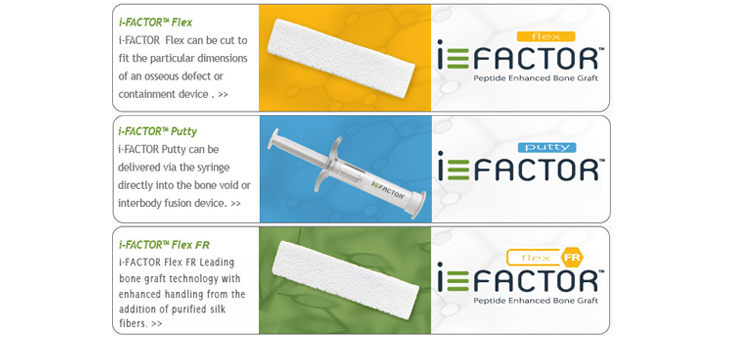
The product has been CE marked for general orthopedic indications in Europe since 2008 and has been used in more than 12, 000 patients. For the U.S. market, pending Food and Drug Administration approval, Marx says that the company will introduce the product as a paste in a syringe. Doctors will be able to shoot it into their intra structural inter body devices in the spine.
Kashuba, in an overview discussion of the technology, defined his product as being very safe, effective and natural. Only osteogenic cells are attracted to it, he said. And as they are attracted to the bone they emit their own bone-growth protein. According to Kashuba, this is a natural process that allows the cells to promote their own internal bone growth factors. He says the company has data to prove i-Factor’s safety and efficacy and to support the firm’s activities.
Author
React:
Discussion
This is a fascinating development. In my practice we've seen similar outcomes with the revised protocol. The key differentiator seems to be patient selection criteria. Has anyone else noticed the correlation with BMI thresholds?
Great point. I'd push back slightly on the conclusion, the sample size in the cited study is too small to draw population-level inferences. That said, the directional signal is compelling and worth a larger RCT.
We implemented a similar approach last year. Early results are promising but we're still gathering 12-month follow-up data. Happy to share our protocol if anyone is interested.
Join the conversation
Orthopedic professionals are discussing this. Sign in and upgrade to read every comment and add your voice.