
In a first for India, according to the Epress News Service of New Delhi, surgeons removed the fused bones of a 19-year-old boy’s skull and jaw and replaced them with a miniature version of implants used in knee joint replacements. The patient, Shivam Sharma, fractured his jaw when he was 10 when he fell from a terrace where he was flying his kite.
Mini-Knee Implants Repair Fused Jaw
2 min read Premium comments
Secondary
Apparently, the broken jaw was never treated. Within weeks, Sharma developed a condition called TMJ ankyloses or fusion of the lower jaw with the skull bone. Doctors said that the condition is seen in cases where physicians fail to treat jaw fractures immediately and the joint is not used for a long period of time.
Surgeon Ajoy Roychoudhury, M.D. explained. “Sometimes children cannot identify a fracture. So they just stop using the joint for a while. Shivam’s parents were feeding him mashed food through the gaps between his teeth, because he could not chew or swallow. He could not even speak properly. His facial structure was asymmetric because of the fusion of the skull and jaw bones. He also had breathing difficulties, ”
Shivam’s case was more severe because the fusion was on both sides of his mouth. “It affected my studies. It was hard making friends because I looked different, ” Shivam said. Surgery performed in 2012 on his jaw was unsuccessful.
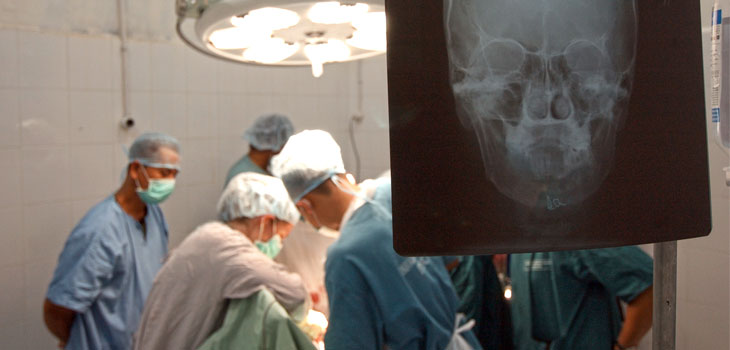
The present surgery took place with specialized anesthesia since Shivam could not open his mouth for the tube. An X-ray before the surgery showed the total fusion of bones. In the surgery, doctors removed the neurovascular structure of the joint, including the nerves and muscular structures, and inserted the imported Federal Food and Drug approved mini-knee implants.
According the doctors in India, who commented on Shivam’s case, 400-450 such surgeries have been performed in Europe and the USA. But this was the first for India. “This is surprising because the incidence of TMJ ankyloses is much higher in Asian countries, particularly India, ” said one of the doctors. They noted that fusion may recur in adult patients after temporary surgical interventions are used to separate the fused bones. “For adult patients, total replacement of the joint with an artificial implant is considered the best treatment, ” said, Ongkila Bhutia, M.D.
Author
React:
Discussion
This is a fascinating development. In my practice we've seen similar outcomes with the revised protocol. The key differentiator seems to be patient selection criteria. Has anyone else noticed the correlation with BMI thresholds?
Great point. I'd push back slightly on the conclusion, the sample size in the cited study is too small to draw population-level inferences. That said, the directional signal is compelling and worth a larger RCT.
We implemented a similar approach last year. Early results are promising but we're still gathering 12-month follow-up data. Happy to share our protocol if anyone is interested.
Join the conversation
Orthopedic professionals are discussing this. Sign in and upgrade to read every comment and add your voice.