
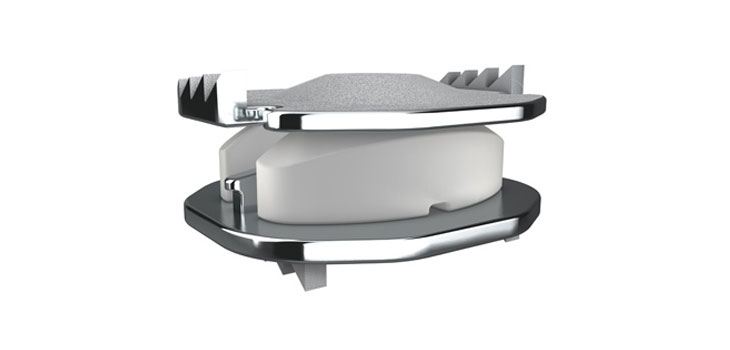
Move over, standard of care…Mobi-C is coming through. LDR Holding Corporation has announced a new study showing that its Mobi-C Cervical Disc is more cost-effective than two-level anterior cervical discectomy and fusion (ACDF). The study, which appears in JAMA Surgery, states that cervical total disc replacement is cost-effective for two-level cervical disc disease, and that over a four year period it imparts a greater quality of life at less cost. The Mobi-C Cervical Disc is the only cervical disc that is FDA-approved for one and two-level use.
LDR Device Fares Well in JAMA Study on Cervical TDR
1 min read Premium comments
Secondary
Working with the University of California Davis Health System Neurosurgery Department, the study’s lead author, Jared Ament, M.D., M.P.H., used clinical data from the two-level Mobi-C vs. ACDF randomized controlled trial in order to assign health states for the patient population. As indicated in the October 29, 2014 news release, the research team “generated Quality-Adjusted Life-Years (QALY) and Incremental Cost-Effectiveness Ratios (ICER) for both treatment groups. An intervention with a lower cost to QALY saved ratio (ICER) would be preferred over an intervention with a higher ratio. The ICER of CTDR [cervical total disc replacement] over ACDF is $24, 594 per QALY, lower than the commonly used U.S. ICER threshold of $50, 000 per QALY, suggesting that CTDR is a ‘highly cost-effective option.’”
In the news release Christophe Lavigne, president and CEO of LDR, stated, “The statistical superiority of Mobi-C compared to ACDF for two-level indications has been demonstrated through the IDE [investigational device exemption] for the overall composite primary effectiveness endpoint at 24 months, and the PMA [pre-market approval] for two-level indications was approved by the FDA in 2013. In today’s U.S. healthcare environment we knew it would be important to determine the cost-effectiveness of Mobi-C as compared to ACDF, the historical standard of care. We are excited to have this very important economic analysis of Mobi-C published, especially in such a prestigious journal as JAMA Surgery. The principal finding of this study, that Mobi-C appears to offer improved cost-effectiveness for two-level replacement (based on the 24 month outcomes), is an important factor for consideration by healthcare providers.”
React:
Discussion
This is a fascinating development. In my practice we've seen similar outcomes with the revised protocol. The key differentiator seems to be patient selection criteria. Has anyone else noticed the correlation with BMI thresholds?
Great point. I'd push back slightly on the conclusion, the sample size in the cited study is too small to draw population-level inferences. That said, the directional signal is compelling and worth a larger RCT.
We implemented a similar approach last year. Early results are promising but we're still gathering 12-month follow-up data. Happy to share our protocol if anyone is interested.
Join the conversation
Orthopedic professionals are discussing this. Sign in and upgrade to read every comment and add your voice.