
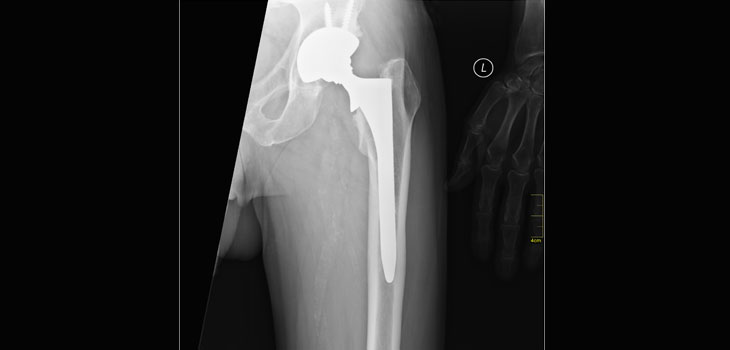
How do young people with juvenile idiopathic arthritis (JIA) who undergo total hip replacement (THR) fare 15 to 20 years out? Researchers from Hospital for Special Surgery (HSS) are enlightening people on this little-researched topic. First of all, they say, THR is an “excellent option” for patients under age 35 when conservative treatments don’t solve the problem. And, in 85% of patients, hip replacement lasted at least 10 years JIA patients. Taken out to 20 years, 50% of the patients needed revision surgery.
HSS: THR “Excellent for” Patients Under 35
2 min read Premium comments
Secondary
“The surgery in this patient population, although performed by only a small number of specialized orthopedic surgeons nationwide, is life-changing for JIA patients, ” said Mark P. Figgie, M.D., senior author of the study and chief of the Surgical Arthritis Service at HSS, in the November 16, 2014 news release. “Joint replacement can free patients from a life of unrelenting pain. It can enable those in a wheel chair to walk again. Patients can go back to school or work and get their lives back.”
“This study followed one of the largest cohorts of patients with JIA to see how they fared 10 years and 20 years after total hip replacement, ” said Ishaan Swarup, M.D., an orthopedic surgery resident at HSS. “It is also one of the few studies to look at patient-reported measures, such as pain and the ability to perform activities of daily living.”
Of the 56 patients involved, 41 patients had undergone bilateral hip replacement, while 15 individuals had only one side replaced; there were a total of 97 hip replacement surgeries. The mean time for follow-up was 12 years.
As noted in the news release, “The researchers found that hip replacement in patients who were 25 or older lasted longer compared to THR in younger patients. There were no other significant differences in implant longevity based on gender or the use of custom versus standard implants. Male patients reported better outcomes with respect to activities of daily living, and patients who had received custom hip implants did worse in their reporting of pain and the ability to perform daily activities.”
“We were not surprised that the patients who received custom implants had lower scores, since the very fact that they needed a custom implant meant they had more severe joint deformities and more severe disease, ” Dr. Figgie explained.
Although a good treatment, Dr. Figgie noted that the longevity of the implants needs to be improved, especially since the patients are so young. “The next step will be to evaluate which factors affect how long the implants last and work on improving implant design and durability, ” he said.
Asked how you approach this, Dr. Figgie told OTW, “In order to analyze the failures, we will review their X-rays and perform retrieval analysis on the implants that were revised here and are in our extensive retrieval collection. We will also perform multivariate statistical analysis to look for factors that lead to failure.”
As for factors that might be involved, he stated, “Failures will most likely come from wear of the polyethylene components and loss of implant fixation.”
Author
React:
Discussion
This is a fascinating development. In my practice we've seen similar outcomes with the revised protocol. The key differentiator seems to be patient selection criteria. Has anyone else noticed the correlation with BMI thresholds?
Great point. I'd push back slightly on the conclusion, the sample size in the cited study is too small to draw population-level inferences. That said, the directional signal is compelling and worth a larger RCT.
We implemented a similar approach last year. Early results are promising but we're still gathering 12-month follow-up data. Happy to share our protocol if anyone is interested.
Join the conversation
Orthopedic professionals are discussing this. Sign in and upgrade to read every comment and add your voice.