
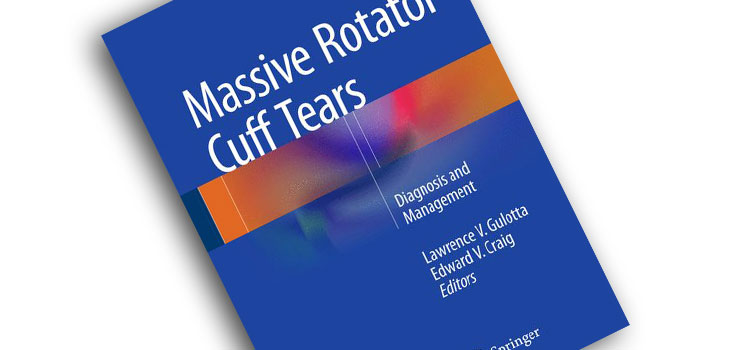
Lawrence Gulotta, M.D. and Edward Craig, M.D. at Hospital for Special Surgery (HSS) have co-authored a new “soup to nuts” 163-page textbook entitled “Massive Rotator Cuff Tears: Diagnosis and Management.”
HSS Surgeons: New Rotator Cuff Textbook
1 min read Premium comments
Secondary
These highly experienced surgeons, both from the Sports Medicine and Shoulder Service at HSS, have highlighted throughout the book that patients may look the same as far as imaging, but in fact may have different clinical manifestations.
“Rotator cuff injury is the most common cause of shoulder pain, and rotator cuff repair is the most common shoulder operation in the world, ” Dr. Craig noted in the October 27, 2014 news release. “As the population ages, and individuals wish to remain active, we are seeing more and more patients with very large, or massive, rotator cuff tears. These tears can be very difficult, if not impossible, to fix. We wanted to provide health care professionals with a textbook that could guide them through all of the treatment options.”
The news release indicates: “The book begins by discussing the structural and functional manifestations of massive tears and goes on to cover the diagnostic work-up, including imaging. The text also delves into the use of biologics and patches, tendon transfers, hemiarthroplasty and reverse total shoulder replacement. A practical treatment algorithm for patients with massive rotator cuff tears is included.”
Dr. Gulotta told OTW, “Surgeons can adopt a ‘one size fits all’ approach that may not exactly achieve the patient’s goals. Some surgeons may embark on repairs that are doomed to fail. Others may indicate a patient for a reverse total shoulder replacement when the patient may be a better candidate for an arthroscopic partial repair. The book helps practitioners navigate these treatment options so that the patient’s goals are achieved in the least invasive way possible.”
React:
Discussion
This is a fascinating development. In my practice we've seen similar outcomes with the revised protocol. The key differentiator seems to be patient selection criteria. Has anyone else noticed the correlation with BMI thresholds?
Great point. I'd push back slightly on the conclusion, the sample size in the cited study is too small to draw population-level inferences. That said, the directional signal is compelling and worth a larger RCT.
We implemented a similar approach last year. Early results are promising but we're still gathering 12-month follow-up data. Happy to share our protocol if anyone is interested.
Join the conversation
Orthopedic professionals are discussing this. Sign in and upgrade to read every comment and add your voice.