
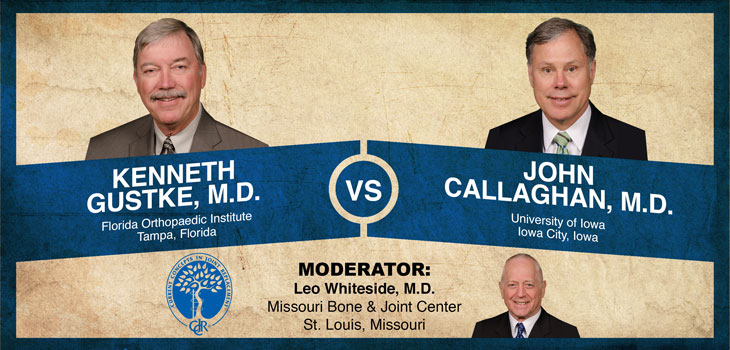
This week’s Orthopaedic Crossfire® debate was part of a landmark event, the first Brazilian CCJR meeting. The event, which took place in September 2014, was held in Iguassu Falls. The topic was “The Posterior Stabilized Knee: No Post Required.” For the proposition is Kenneth Gustke, M.D. of Florida Orthopaedic Institute; against the proposition is John Callaghan, M.D. of the University of Iowa. Moderating is Leo Whiteside, M.D. from Missouri Bone & Joint Center.
Gustke Debates Callaghan: Ultracongruent Liners or Posterior Stabilization
7 min read Premium comments
Great Debates
Dr. Gustke: “There are two popular options: a standard posterior stabilized component with a post and cam. The alternative is an ultracongruent liner. Over 50% of the total knees done in the U.S. are of a posterior stabilized (PS) design. The popularity is justified if you look at the survivorship figures: 97% at 15 years.”
“With a PS you get increased knee flexion from forced femoral rollback and you don’t have to worry about posterior cruciate ligament (PCL) balance. But complications can occur that are unique to the PS design. Many patients say that they feel clicking. The sound isn’t the problem, but the sound comes from impingement between the post and cam.”
“A retrieval study found that over 30% of PS designs demonstrated some significant wear. The ultimate outcome of wear is a post fracture; this is due to excessive implant velocity that occurs when the post strikes the femoral cam. Then there is dislocation of the post jumping. Lombardi showed that even though it’s a small occurrence it can occur in well balanced knees at around 20 degrees of knee flexion if the post is short.”
“More common is patellar clunk syndrome, which occurs because of hypertrophic scarring at the superior pole of the patella from soft tissue impinging on the proximal portion of the intercondylar notch. This is unique to the PS because the intercondylar notch extends more anteriorly to prevent post impingement and hyperextension.”
“You’re also going to have to remove more bone. Doing this, especially in small femurs—if the box sizes are the same—could be a risk for periprosthetic fracture. There’s also a concern that this hard stop that occurs because of the post engagement may increase stress on the tray locking mechanism and cause increased backside wear. A report looking at Insall-Burstein IIs at six years shows 16% osteolysis. The wear issues have motivated many of the manufacturers to pursue mobile bearing type liners with their PS designs.”
“So is the rotating platform (RP) the savior of the PS design? Theoretically, you’ll have decreased polyethylene wear. But studies have shown that there’s really no significant difference in wear when compared to a fixed bearing—although there is some aseptic loosening and osteolysis seen at 10 years. But there’s perhaps an increased risk of clunk syndrome. And it creates new problems, such as bearing spinout in 1-5%; soft tissue impingement and crepitation that necessitates reoperation in up to 4% of cases; unexplained hemarthrosis.”
“The ultracongruent liner has an increased anterior poly buildup of 10-12.5mm. It has a more conforming surface when the knee is in extension…and it’s less conforming in flexion. And it’s a dynamic stabilizer rather than a static stabilizer, so there’s less stress on the locking mechanism. There’s no high velocity impingement on the post…and it provides resistance to posterior subluxation throughout the entire knee range of motion.”
“In a study done in Seth Greenwald’s lab they showed that at 90 degrees of flexion PS and ultracongruent liners are fairly similar. But at full extension ultracongruent liners provide better stabilization than a PS. There are some comparison studies in the literature looking at ultracongruents vs PS. Parsley and Argenson showed equal range of motion (ROM), knee scores, and patient satisfaction scores.”
“My philosophy is to always try to save the PCL. If it’s appropriate rollback I retain the PCL, but if it’s too tight I would either increase the slope, do a partial PCL release, or substitute with an ultracongruent liner. On my last follow-up the average Knee Society score was 93; knee flexion was 117 degrees. With one known revision for poly wear (with a new insert only), and one revision for instability.”
Dr. Callaghan: “Why should he put in an insert without the post? There’s no question that you can get conformity without the post. I found two articles related to that liner, and the one prospective randomized study that Ken alluded to. None of them had long term follow-up. In 2014 Peters from Utah reported on cases from 2003-2008; there was a minimum two year follow-up and the aseptic revision rate was only 0.88. The ROM in that study was 110 degrees.”
“You can have mobility without congruity, congruity without mobility, and mobility with congruity. What Ken mentioned was congruity without mobility, which can put high constraint forces on the interface below that on the tibia. The other option is the cruciate retaining (CR) type of design.”
“So why an ultracongruent insert? Conforming inserts are beneficial to prevent posterior subluxation of the tibia. Those of you who know the LCS (low contact stress) knee know that it’s very ultracongruent. The issue is not with revision…it’s a problem with ROM. The average motion in our study was only 105 degrees. It’s well understood now that to get motion you have to have rollback. After 90-110 degrees of motion you need rollback…and a post provides that. I don’t see how an ultracongruent liner could possibly do that.”
“In a fluoroscopic study, Komistek showed that an ultracongruent liner stays in the center of the dish…you never get rollback. With a PFC (press fit condylar) type of design, however, that post gives you rollback and allows you to flex to 115 or 140 degrees (depending on how you design the prosthesis).”
“CR, PS, RP…they all have very low failure rate in the registries. When you look at meta analyses or follow-ups of multi-institutional studies you see that the PS design has better motion.”
“Chit Ranawat’s recent work shows a 95% satisfaction rate, so the not having a quiet knee issue that Ken brought up isn’t true today. The failures in Chit’s group, as with a lot of groups today, are infection and traumatic fractures—not revision for loosening. The ROM in this group was 119 degrees.”
“The motion all occurs at the top in a fixed bearing, whereas with a mobile bearing the rotational motion is at the lower bearing surface. Retrieval analyses have demonstrated less cam/post damage with a mobile bearing PS than with a fixed bearing PS. As for clunk, we’ve shown about a 1.2% prevalence. It’s very design specific. If the box is recessed it is better.”
“Ultracongruent is good, but good is the enemy of great. A PS gives you that.”
Moderator Whiteside: “Ken?”
Dr. Gustke: “There’s no question that a PS knee gives you good results. And what you alluded to is that a PS by its design forces the rollback and allows for increased flexion. But my results with flexion are very similar to the results of a PS knee’s flexion. And even though there may not be as much rollback that’s forced, it’s still functional and gives excellent ROM.”
“The other thing with an ultracongruent liner is that it’s not a total condylar device…it’s not congruent throughout the entire knee ROM. So if the soft tissues allow for some posterior glide of the glide of the femur on the tibia then it can allow for it. The reason that the literature isn’t full of articles is because this implant hasn’t been adopted by a lot of manufacturers because they have PS designs.”
Moderator Whiteside: “Ken, have you seen any downsides to the deep dish polyethylene?”
Dr. Gustke: “No, and I use it frequently in revisions. It’s my go-to liner for revisions without a posterior cruciate ligament.”
Moderator Whiteside: “I’ve occasionally found cases where the tibia slipped back on the lateral, but not the medial…and the medial side was so prominent that it had to be trimmed.”
Dr. Gustke: “The issue with anterior buildup is whether it’s going to rub on the patellar tendon or the inferior bone of the patella. Most designs now allow for a cutout of the mid-portion of the ultracongruent liner anteriorly. If you ever see issues where it may impinge then you just take a beaver blade and trim it off.”
Moderator Whiteside: “John, what about the Mayo Clinic study showing a higher failure rate after about 10-15 years in PS knees?”
Dr. Callaghan: “Maybe it’s because they didn’t get the motion that you get with a CR knee. It wouldn’t surprise me to see some studies out to 15 years by good surgeons with a little higher failure rate.”
Dr. Gustke: “Part of the issue with that study was that the implant used didn’t have a very good locking mechanism. It’s that backside wear from the constant velocity of the post hitting the cam, causing a locking mechanism to loosen the poly and generating backside wear. The other issue you have with the post is that you can’t highly crosslink it.”
Dr. Callaghan: “I think with antioxidant poly that this may not be an issue in the future.”
Moderator Whiteside: “I’ve seen enough studies of mobile bearing poly with under surface wear that it makes me concerned that you have a plastic post wearing and a major underside of the poly wearing…and another post down the center of the tibia. Are we going to have a volumetric wear issue?”
Dr. Callaghan: “The problem with the retrievals is that they are the result of failures. If you get anything under a mobile bearing then it may be the worse thing you’ve ever seen. That’s why you go cementless.”
Moderator Whiteside: “John, the open box geometry is still up for debate, right?”
Dr. Callaghan: “If you have an open box then you must be a lot more meticulous about getting all of the cement out and preventing excess bone from being in there.”
Moderator Whiteside: “Thank you both.”
Please visit www.CCJR.com to register for the 2014 CCJR Winter Meeting, December 10 – 13 in Orlando.
Author
React:
Discussion
This is a fascinating development. In my practice we've seen similar outcomes with the revised protocol. The key differentiator seems to be patient selection criteria. Has anyone else noticed the correlation with BMI thresholds?
Great point. I'd push back slightly on the conclusion, the sample size in the cited study is too small to draw population-level inferences. That said, the directional signal is compelling and worth a larger RCT.
We implemented a similar approach last year. Early results are promising but we're still gathering 12-month follow-up data. Happy to share our protocol if anyone is interested.
Join the conversation
Orthopedic professionals are discussing this. Sign in and upgrade to read every comment and add your voice.