
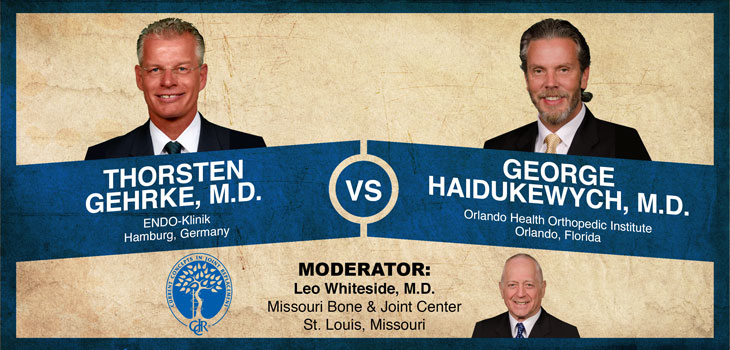
This week’s Orthopaedic Crossfire® debate was part of a landmark event, the first Brazilian CCJR meeting. The event, which took place in September 2014, was held in Iguassu Falls. The topic was, “Mega Prostheses for Well Fixed TKA Femoral Fx’s.” For the proposition is Thorsten Gehrke, M.D. from ENDO-Klinik in Hamburg, Germany; against the proposition is George Haidukewych, M.D. of Orlando Health Orthopedic Institute. Moderating is Leo Whiteside, M.D. from Missouri Bone & Joint Center.
Gehrke Debates Haidukewych: Mega Prostheses
7 min read Premium comments
Great Debates
Dr. Gehrke: “In our practice we see a lot of failures, including periprosthetic fractures. Recently, Clive Duncan and Fares Haddad published the unified classification system, which is great because it includes almost everything. For periprosthetic fractures they divided it into good bone, no implant loosening (B1), good bone with implant loosening (B2), and poor bone with implant loosening (B3). They forgot to include B4, which means poor bone, but well-fixed implant.”
“Of course we have many options, including retrograde nailing, intramedullary nailing, less invasive stabilization systems, non-contact bridging plates with polyaxial locking screws. These are all good options and they can work well. But if we look at a recent paper from India we see that the locking plates in 25% were in need of revisions. The major problem with locking plates is nonunion. In this paper they compared intramedullary nailing with the periarticular locking plates. They found that the locking plate group had nonunion or delayed union in 19%; it was 9% in the intramedullary nailing group.”
“Theoretically, nails are good in all kinds of fractures, but they have limited use it you like to use them in combination with total knee arthroplasty (TKA). If you have a closed box you have no chance of putting a retrograde nail in to treat the periprosthetic fracture. Mega prostheses can be an option.”
“Some of the distal femur replacements have too short of an anchoring distance, so they fail. You can only solve this by switching to a total femur replacement. In a paper comparing allograft with a revision system vs distal femur replacement and found that the operative time and blood loss were significantly less in distal femur replacement. A study by Antonia Chen showed that there were significantly more surgical procedures for open reduction and internal fixation (ORIF) to distal femur replacement compared to primary distal femur replacement that may be preferred in osteopenic patients.”
“In another study they used mega prostheses in cases of periprosthetic fracture around the knee arthroplasty. They did 11 patients without the need for reoperation. Mega prosthesis can also be a good solution in elderly and osteopenic patients because they provide immediate stability and allow early mobilization.”
“If you have a very old patient with an internal prosthetic fracture, you can use this device we developed—an interposition device which allows you a very quick salvage of the situation. And a recent experimental approach that we did involved something I call the ‘coffin lid.’ If you have two well-fixed implants in an interprosthetic fracture then we use a strut graft to solve this problem.”
Dr. Haidukewych: “I’ll concede that mega prostheses do have a role in the treatment of fractures above a well fixed total knee, but a very limited role…less than 10% in my practice. Perhaps in those very distal fractures with osteolysis where internal fixation is likely to fail. ORIF does remain the gold standard for these fractures. There are no published prospective randomized studies comparing modern ORIF to mega prostheses to substantiate any benefit of one choice over another in regards to outcomes, cost, disposition, or hospital stay.”
“Periprosthetic fractures are becoming more common. They are usually due to low energy falls and they always occur right at the flange of a very well fixed femoral component. The most common scenario we see in the U.S. is that the knee is functioning well, it’s well fixed, and the fracture is a supracondylar femur fracture. The goals of treatment are to maximize distal fixation, get the fracture to heal in the correct alignment. The challenges include: osteopenic bone, short distal fragments that offer limited opportunity for internal fixation, and obstacles to distal fixation by parts of the femoral component.”
“Two general trends exist in the U.S., namely, some form of submuscular locked plating and some form of retrograde nailing with multiplanar angle stable locking screws. Nails are tissue-friendly and mechanically sound, but you do need good notch access and it’s hard to avoid malalignment. Most modern total knees have good notch access for retrograde nailing. I do these through an arthrotomy so that I don’t damage the arthroplasty. I allow full weight bearing and early range of motion (ROM) on these constructs. Do not use short retrograde nails; most manufacturers are abandoning these for good reason.”
“As for plating, lock plates offer coronal plane stability and can be used in any fracture…regardless of notch access. The advantage of an angled stable lock plate versus a single point of fixation with older implants is that you can get extremely distal—even fractures that go distal to the femoral flange. We no longer use any form of allograft struts or cerclage anywhere near the metaphysis because that’s a good way to get a nonunion.”
“Every manufacturer now offers some way to angle and lock a screw, which is particularly advantageous in a periprosthetic fracture. Again, this lets you get good fixation very, very distally. And if you leave it alone it will heal biologically. The technique is the same whether you nail or plate. I like to prep the well leg and keep it out of the way. Not only is that a good control for alignment, leg length and rotation, but you can lift it over the C arm and not have to lift a fractured limb when you place your fixation. Avoid hyperextension by carefully positioning your bump; place your plate or nail, bridge the fracture, leaving the metaphyseal area alone…and this will heal predictably.”
“Most systems offer all sorts of gizmos to help you get good reductions; they can be helpful in doing a nice minimally invasive job on these fractures. Multiple series worldwide show that we can expect a union rate of well over 90%, with nails trending a bit better than locked plates.”
“So why not perform a mega prosthesis for these fractures? Proponents will say that you can allow full weight bearing, there’s no fracture to heal, and early ROM. The disadvantages are that they are extremely expensive—at least 10-15 times more expensive than a nail. The complication rates are in the double digits, it requires expertise, and they almost all have some sort of extensor mechanism problem. If ORIF fails I can put in a mega prosthesis. What do you do if a mega prosthesis fails? Just keeping adding segments until we get up to the hip, apparently.”
“If you look at the complications with mega prostheses, Schwab showed that more than half had some sort of patella problem. The other complications are not insignificant, but in fact are well into the double digits. Many series have summarized this. Distal femoral replacements have a high rate of complication; the procedure should be reserved for patients for whom alternative treatments are not possible. I do a mega prosthesis as a last resort, with a very distal fracture, with severe osteolysis, non-unions, and those who have had multiple operations.”
Moderator Whiteside: “Thorsten?”
Dr. Gehrke: “I agree that if you have very good bone stock and you can’t solve the problem with a nail or plate I would do the same as you. The mega prosthesis is a very limited solution, but think about it as a solution in old patients and osteopenic patients with poor bone stock who need a quick procedure and fast mobilization.”
Moderator Whiteside: “What about the patellar issues?”
Dr. Gehrke: “You have to find out the right rotation, which is the most important part of the tibial and femoral component. Then we don’t see many complications with patellar tracking.”
Moderator Whiteside: “That’s what I see the most, i.e., patellar complications. I’m concerned that the patellar groove is not adequate and that the patellar tracking mechanism has been resected. You haven’t seen that as a significant issue?”
Dr. Gehrke: “No. If you respect all the rules about the joint line and rotation of the components then you don’t see if often.”
Moderator Whiteside: “George, do you get referred patients with patellofemoral issues after a mega prosthesis?”
Dr. Haidukewych: “This occurs not only in referred patients, but in my own. They’re too small and the trochlea isn’t friendly for an unresurfaced patella or one that’s been resurfaced. You basically resect all the distal soft tissue, so they never track well. They almost always need a lateral release.”
Moderator Whiteside: “What do you do when you have persistent patellar dislocation with this prosthesis?”
Dr. Haidukewych: “I do a proximal realignment.”
Dr. Gehrke: “In 2005 we published 100 consecutive cases with total femur replacements. We found patella problems only in 5% of patients; I don’t think that this is the main issue here.”
Moderator Whiteside: “Is this a cemented stem?”
Dr. Gehrke: “Until two years ago we used cemented stems almost exclusively, but we have now switched to cementless in some patients. I think the cementless stems are working better than the cemented stems.”
Moderator Whiteside: “George, what do you do about rotational alignment of the distal femur when you have a highly comminuted fracture and you’re plating it?”
Dr. Haidukewych: “Whether plating or nailing it’s the same issue…you need to have some comparisons. I’ll have the other leg prepped in. When I pass my fixation device I will place the screw above or below then flex the knee and check rotation compared to the other side. And check your tracking, like you do with any other TKA. When you’re done fixing it you compare it to the other leg and take the knee through a range of motion and hopefully you would pick up if you missed a little bit or internally rotated something.”
Moderator Whiteside: “What companies make these plates available?”
Dr. Haidukewych: “All companies have multi-angled locking stable screws.”
Moderator Whiteside: “Thank you both.”
Please visit www.CCJR.com to register for the 2014 CCJR Winter Meeting, December 10 – 13 in Orlando.
React:
Discussion
This is a fascinating development. In my practice we've seen similar outcomes with the revised protocol. The key differentiator seems to be patient selection criteria. Has anyone else noticed the correlation with BMI thresholds?
Great point. I'd push back slightly on the conclusion, the sample size in the cited study is too small to draw population-level inferences. That said, the directional signal is compelling and worth a larger RCT.
We implemented a similar approach last year. Early results are promising but we're still gathering 12-month follow-up data. Happy to share our protocol if anyone is interested.
Join the conversation
Orthopedic professionals are discussing this. Sign in and upgrade to read every comment and add your voice.