
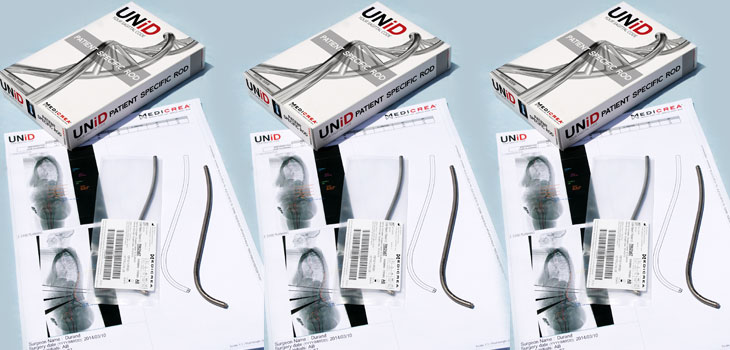
The French-based Medicrea Group says it has received FDA 510(k) clearance for its UNiD spinal device, which according to the company, is the world’s first patient-specific spinal osteosynthesis rod to treat degenerative spine conditions including scoliosis.
FDA Clears First Patient-Specific Spinal Rod
3 min read Premium comments
Secondary
The technology was introduced at the 2014 North American Spine Society (NASS) Annual Meeting on November 12, 2014 in San Francisco, California. The first U.S. patient underwent surgery to have personalized UNiD rods implanted on November 10, 2014 in New York. The surgery was performed by Frank J. Schwab, M.D. The system has been implanted in over 100 patients in Europe.
UNiD Features
The system, according to the company, features a “user-friendly software tool to help surgeons preoperatively plan their surgery and order customized, industrially-produced rods to fit the specific spinal alignment needed for each individual patient.” The company says the device reduces the amount of time a patient spends in the operating room because there is no need to manually contour a rod during surgery. The surgeon is provided with a “precisely aligned” rod prior to surgery. Less time in the operating room impacts infections rates and quality of recovery.
Until now, surgeons have had to use a bending device, known as a French bender, supplied in all instrument kits to bend the rods manually. This manual rod-contouring process involves estimating the curve in a very empirical manner using pre-operative X-rays displayed on a wall in the operating room.
“Improved” Economic Outcomes
“UNiD rods provide surgeons a very precise surgical method, supporting better patient care and improved economic outcomes, ” said Denys Sournac, founder, CEO and chairman of the company. He added that FDA clearance of UNiD is a major milestone for the company. “We started working closely with the FDA nearly two years ago on that strategic approval and this newly obtained clearance marks the culmination of years of research and surgery planning to bring a patient-specific spine implant to market as well as the beginning of a new exciting era in spine surgery.”
UNiD Lab
In addition to the device itself, the system offers the UNiD Lab, which, according to the company, “provides a seamless process by which surgeons preoperatively analyze, design and order the patient-specific rod.” The UNiD plug is proprietary to Medicrea and is embedded into the Surgimap software, and provides surgeons a quick and efficient option for ordering patient-specific rods. “After the planning process is complete, the order is transferred to the UNiD Lab, which processes the request and industrially produces and labels the rod specifically for the patient.”
As soon as the surgeon validates the rod’s design in the UNiD application, the company manufactures the rod and delivers it within five working days.
The company said its “groundbreaking” rods include the “most current clinical data and software development along with the latest in personalized production and industrialization to revolutionize how spine surgery is performed. UNiD rods provide surgeons a very precise surgical method, supporting better patient care and improved economic outcomes.”
Large and Growing Market
The rods address a large market.
According to the National Scoliosis Foundation, an estimated six million people in the U.S. have scoliosis. The company said scoliosis patients make more than 600, 000 visits to private physician offices each year, and an estimated 38, 000 patients undergo spinal fusion surgery.
According to the press release: “Adult spinal deformity surgery is likely to increase in frequency with as much as 32% of the adult population suffering from scoliosis and a prevalence of 60% among the elderly. Hospital costs of adult spinal deformity surgery can exceed $100, 000 per patient. Revisions and reoperations place a large financial burden on the health care system—increasing the average cost of adult spinal deformity surgery by more than 70%. The market for revision surgeries is growing at a significant rate because of the number of corrections performed with approximation errors and misalignment over the past 20 years.”
Author
React:
Discussion
This is a fascinating development. In my practice we've seen similar outcomes with the revised protocol. The key differentiator seems to be patient selection criteria. Has anyone else noticed the correlation with BMI thresholds?
Great point. I'd push back slightly on the conclusion, the sample size in the cited study is too small to draw population-level inferences. That said, the directional signal is compelling and worth a larger RCT.
We implemented a similar approach last year. Early results are promising but we're still gathering 12-month follow-up data. Happy to share our protocol if anyone is interested.
Join the conversation
Orthopedic professionals are discussing this. Sign in and upgrade to read every comment and add your voice.