
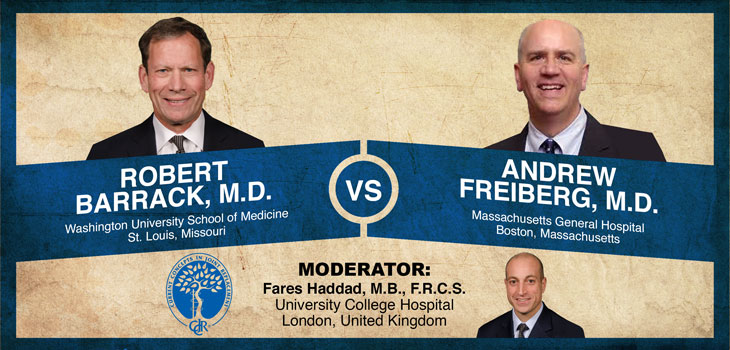
This week’s Orthopaedic Crossfire® debate was part of a landmark event, the first Brazilian CCJR meeting. The event, which took place in September 2014, was held in Iguassu Falls. The topic was, “Patella Resurfacing: Rarely, if Ever, Necessary” For the proposition is Robert Barrack, M.D. of Washington University School of Medicine in St. Louis. Against the proposition is Andrew Freiberg, M.D. of Massachusetts General Hospital. Moderating is Fares Haddad, M.B., F.R.C.S. of the University College Hospital in London, United Kingdom.
Barrack v. Freiberg Over Patella Resurfacing
7 min read Premium comments
Great Debates
Dr. Barrack: “If patella resurfacing is not done by an expert hand then you find over resection, under resection, an oblique resection, or a disruption in the blood supply. There are a lot of negative sequelae of resurfacing, and these are very underreported. The question is, ‘How often do these occur?’”
“Merrill Ritter’s group always resurfaces the patella. They report 4.2% failures in less than three years and very few were revised (CORR 2001). But this was an average of only 5 years so what’s going to happen to these at 10 years? We looked at the question of which presents more clinical problems after knee replacement, resurfacing the patella or not resurfacing the patella. St. Louis is a city where about 50% of the patellas are resurfaced and half are not. We maintained records over a four-year period on all patients sent to us who were complaining of anterior knee pain after a total knee replacement [TKR]. During that timeframe we had 47 cases, of which three-fourths had actually been resurfaced. So in a city where half the patellas are resurfaced and half are not, three-fourths of patients were coming in complaining of anterior knee pain with a resurfaced patella.”
“Of those treated surgically, the rate of reoperations was about the same as those treated non-surgically, but there were 4x as many resurfaced patellas that were re-operated on. We saw a lot of early loosening and patella revision; fragmented patellas were also common…loose component that you remove and hope that you maintain continuity of the extensor mechanism. We also saw avascular necrosis [AVN] of the patella; there is no treatment for this. We also saw a lot of late stress fractures. And lateral facet pain was very common when you get oblique resurfacing on an unbalanced patella. Oblique resurfacing was the second most common phenomenon we saw. In one operative case the patella was thick enough that we got some symptom relief.”
“We found a 3x higher incidence of problems from resurfacing the patella. The severities of the complications were substantially higher and treatment options were more limited. If you look at our randomized clinical trial, by 10 years the resurfaced patellas had declined more than the unresurfaced. The most compelling study is a randomized trial from Oxford that included 1, 700 knees. They found no difference in any score. In a meta-analysis (He et al., The Knee, 2011) the reoperation rate was lower for resurfacing, but reoperation isn’t reliable because subsequent resurfacing is undertaken because it’s perceived as an easy bailout.”
“The advantages to not resurfacing the patella are that it’s faster, cheaper, there are lower risks of major complications, and you have more options if symptoms do persist. The fact is that a small percentage of patients in each group will be symptomatic. But which retains more options and which has more complications? So the major determinant of a clinical result in the presence of anterior knee pain after total knee is a surgical technique and component design…not whether or not the patella is resurfaced. I do occasionally resurface the patella if it’s deformed and not tracking. But for the vast majority it’s simply not necessary and counterproductive.”
Dr. Freiberg: “Robert, now I know why so many people limp in St. Louis. I believe that patella resurfacing should be done in virtually all patients. The reason is because I don’t want to re-operate on my patients. Robert told you that patients do well whether their patella is resurfaced or not. And although Robert showed a lot of cases of patella failure, those were in older designs and older techniques. I think with current designs and techniques patella resurfacing can be done easily, quickly, and predictably.”
“The initial failure rate of patella resurfacing in the 1980s was quite high. The issues were: thin poly, metal backing, and not understanding how to do the technique. It represented a large portion of knee revisions. If we look at the literature, at our experience, and our practices today, less than 3% of revision total knees are for failed patellas.”
“Patella femoral complications are less frequent due to improvements in prosthetic design and surgical technique. Resurfacing patients have less pain, the procedure is easy, it’s not that expensive, adds only about 5-10 minutes to the procedure, and result in lower revision rates. Looking at the unresurfaced groups, about the only thing you can find in the literature is perhaps a decrease in patella fracture at 15 years.”
“A meta analysis of 18 Level 1 randomized clinical trials representing 7, 000 knee replacements found that the reoperation rate was higher in the unresurfaced patella group, as was anterior knee pain (Pavlou et al., JBJS, 2011). A forest plot shows that patella resurfacing reduces the incidence of reoperation; the risk of revision was reduced by 50% using patella resurfacing. Five trials favored resurfacing; only one trial favored no resurfacing. In seven trials there was no difference. While the forest plot was not statistically significant, there is a trend favoring resurfacing with respect to anterior knee pain.”
“Midterm data from the Australian registry (with almost 135, 000 knees), shows revision for any reason was reduced 25% by patella resurfacing. Revision for patella pain was 17% in the unresurfaced group versus 1% in the resurfaced group. For patella-only revisions, 29% for unresurfaced versus 6% in the resurfaced group. Long term registry data from Norway (representing about 11, 000 knees) shows that the risk of revision was reduced by 16% in the resurfacing group. Regarding knee pain, patella resurfacing patients had a remarkably lower revision rate.”
“I resurface the patella because I don’t want my patients to be in pain after TKR. I only want to operate on my patients once.”
Moderator Haddad: “Robert?”
Dr. Barrack: “I’d say that the registry data is difficult to interpret, and in most of the countries that you reviewed the patella is not resurfaced in a high percentage of cases. We selectively choose registries…you quote registries like Sweden where they cement all their total hips. We don’t cement any of our total hips. The problem with registry data is that it’s pooled. Clearly, there are a number of designs that are not designed for an unresurfaced patella. There are even symmetric designs that don’t have ‘lefts’ and ‘rights.’”
“So if you only include designs that are reasonable for a unresurfaced patella, there are several designs in the registries that perform better, have lower revision rates. If you use a component that’s designed for an unresurfaced patella rather than pooling all of the data then it’s really not relevant…and you will conclude that you can easily perform a total knee without patella resurfacing and get equal or better results.”
Moderator Haddad: “Andy, if we split your data into patella friendly and non-patella friendly total knees, do you have a feel for that?”
Dr. Freiberg: “It’s difficult to look at a design…”
Dr. Barrack: “It’s not difficult at all because the registries stratify by design, and there are a number of designs that perform as well or better with an unresurfaced patella…so just use one of those components and you’ll do fine.”
Dr. Freiberg: “You’ll have to let me finish my sentence, Robert. I think we can look at the type and design of the actual implant, but I think the characteristics that make an implant patella friendly are a complex thing to talk about. My point with the registry data is that for reoperation it is as clear as it’s going to get. You can look at pain and function, but reoperation—which is higher in the unresurfaced group—pushes us toward doing patella resurfacing.”
Dr. Barrack: “That’s not a logical conclusion from the registry data because if you have a procedure that is perceived as a possibility, clearly the reoperation rate is higher. And a high percentage of the reoperations are because there’s a perception that you can do something else. When you resurface a patella you really can’t do anything else. Reoperation is not a reasonable endpoint for that reason. The other problem is that when you resurface a patella and you have fragmentation, AVN, or you just remove the component that’s much less likely to be captured by the registry. So you must be more specific about quoting registry data.”
Moderator Haddad: “The tough one is the patient with anterior knee pain after a TKR where the patella is not resurfaced. Who should go on to have an operation and who shouldn’t?”
Dr. Barrack: “It’s more frequent for us to have patients referred with anterior knee pain with a resurfaced patella. The problem is that once you have a resurfaced patella then you have fewer options. If you’re going to resurface the patella in 100 patients to avoid the two or three that may have some problem, you’re exposing a lot of patients to an unnecessary procedure. For the handful that do have a problem, you have many options as to where you place the component.”
Dr. Freiberg: “The results of patients who have patella resurfacing are inferior if they had not had it done the first time. Also, the legal issues around not resurfacing are particularly difficult in TKR. Do you do partial knee replacement, Robert?”
Dr. Barrack: “No, I do a TKR without patella resurfacing. It’s fairly standard in our community and our patients do as well or better than they do in Boston.”
Question from audience: “You really need skills to resurface the patella because it’s a third procedure. You’re doing the femur, the tibia, and then this third procedure.”
Dr. Barrack: “Insightful point. The problem is that it’s the highest volume procedure in the U.S. and this occurs at the very end of a case and it’s done quickly. We see more complications from that part of the procedure than any other.”
Dr. Freiberg: “I’d suggest that a capable knee surgeon could make one extra flat cut.”
Moderator Haddad: “Thank you, gentlemen.”
Please visit www.CCJR.com to register for the 2014 CCJR Winter Meeting, December 10 – 13 in Orlando.
React:
Discussion
This is a fascinating development. In my practice we've seen similar outcomes with the revised protocol. The key differentiator seems to be patient selection criteria. Has anyone else noticed the correlation with BMI thresholds?
Great point. I'd push back slightly on the conclusion, the sample size in the cited study is too small to draw population-level inferences. That said, the directional signal is compelling and worth a larger RCT.
We implemented a similar approach last year. Early results are promising but we're still gathering 12-month follow-up data. Happy to share our protocol if anyone is interested.
Join the conversation
Orthopedic professionals are discussing this. Sign in and upgrade to read every comment and add your voice.