
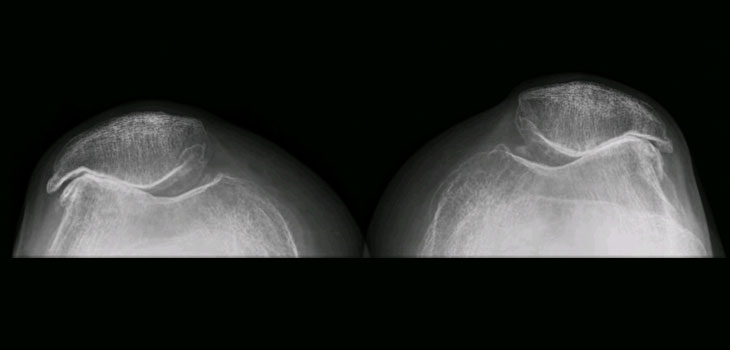
“Listen to your body, ” goes the old adage. Researchers in the UK, it seems, are doing just that. A team from the Lancaster University is using a portable device with microphones to listen to sound waves in the knee. The goal? Detect osteoarthritis (OA) and see if those receiving treatment are improving.
UK Researchers Use Microphones to Detect OA
1 min read Premium comments
Secondary
The device was developed by researchers at Lancaster University, University of Central Lancashire, Manchester University, the National Health Service and industry. As noted in the October 21, 2014 news release, “microphones are attached to the knees of patients, and the high frequency sound waves emanating from their knees are measured as they stand up.” The team plans to recruit over 200 patients to test the technique.
Lancaster University’s Professor John Goodacre, who is also a consultant rheumatologist, said in the news release: “Potentially, this could transform the ways in which knee osteoarthritis is assessed and treated. Unlike an MRI scan, this approach can tell you what happens when the joint moves and it can also measure how the knee is changing over time.”
“Researchers are only just starting to explore the idea of listening to structures like joints, arteries or the intestines and seeing if the sounds they make can tell us about diseases. So this is a new field and the UK is leading in this area.”
React:
Discussion
This is a fascinating development. In my practice we've seen similar outcomes with the revised protocol. The key differentiator seems to be patient selection criteria. Has anyone else noticed the correlation with BMI thresholds?
Great point. I'd push back slightly on the conclusion, the sample size in the cited study is too small to draw population-level inferences. That said, the directional signal is compelling and worth a larger RCT.
We implemented a similar approach last year. Early results are promising but we're still gathering 12-month follow-up data. Happy to share our protocol if anyone is interested.
Join the conversation
Orthopedic professionals are discussing this. Sign in and upgrade to read every comment and add your voice.