
Researchers from the University of Michigan Health System have made progress in treating those in unusual situations: individuals burned by high-velocity explosive devices whose body turns on them and begins a process known as heterotopic ossification (HO) wherein bone begins growing where it should not be.
Treatment for Burns that Cause Heterotopic Ossification
2 min read Premium comments
Secondary
According to the September 25, 2014 news release, the research team made use of apyrase, a compound capable of breaking down ATP (adenosine triphosphate), and were able to reduce HO. “They confirmed the link between burn injury and activity of ATP, a primary energy source for cells that, when elevated, can make reactions normally impossible in biological conditions, possible—such as ectopic, or abnormal, bone. In addition to burn and trauma patients who are at risk for HO, more than one million patients a year undergo joint replacement in the United States and 20% of these patients will develop HO.”
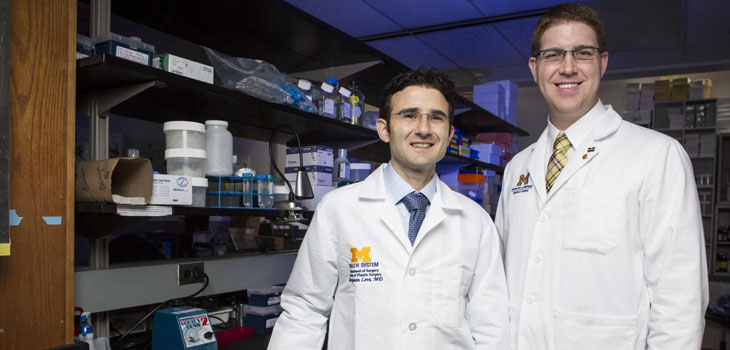
Benjamin Levi, M.D., is director of the Burn/Wound and Regenerative Medicine Laboratory at the University of Michigan. He told OTW, “One of the most interesting results we saw was reduction of HO formation at a site distant from where we applied treatment. This was exciting in the context of one of the more difficult aspects of treating HO—not knowing where HO will form. For example, HO often develops in an uninjured joint following a major burn injury. By treating a burn wound on the dorsum of mice with apyrase we saw a reduction in the formation of HO at the distant Achilles tenotomy site. This effect on distant sites with local treatment speaks to the importance of the global inflammatory response to burn/trauma and its effect on osteogenicity of cells that form HO.”
He added, “HO is a common complication of joint replacements. We saw a reduction in HO following early treatment with anti-inflammatory apyrase in our model. A similar strategy may be useful in preventing HO following orthopedic procedures with early, targeted application of anti-inflammatory compounds.”
“The treatment of HO with surgery or radiation is very difficult and often has sub-optimal results including recurrence and need for further surgery. Like many complications of surgery and trauma, the best treatment strategy is prevention, especially because the location of HO cannot always be predicted. More research needs to be conducted to delineate the signaling pathway and cells involved in HO so that specific inhibitors can be developed. The role of anti-inflammatory treatment is also an important consideration.”
React:
Discussion
This is a fascinating development. In my practice we've seen similar outcomes with the revised protocol. The key differentiator seems to be patient selection criteria. Has anyone else noticed the correlation with BMI thresholds?
Great point. I'd push back slightly on the conclusion, the sample size in the cited study is too small to draw population-level inferences. That said, the directional signal is compelling and worth a larger RCT.
We implemented a similar approach last year. Early results are promising but we're still gathering 12-month follow-up data. Happy to share our protocol if anyone is interested.
Join the conversation
Orthopedic professionals are discussing this. Sign in and upgrade to read every comment and add your voice.