
Ready or not and 33% incomplete, CMS (Centers for Medicare and Medicaid Services) released the first round of Open Payments data on September 30, 2014.
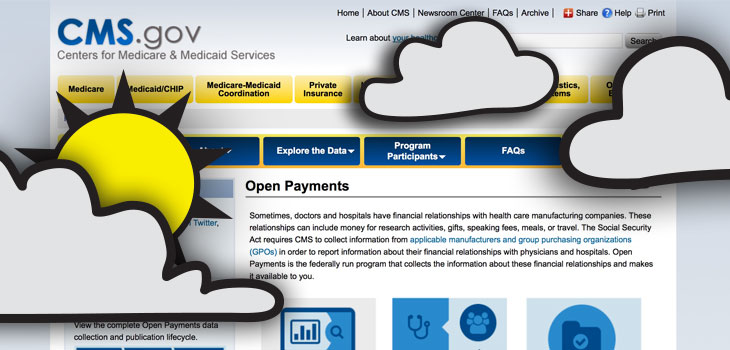
Sunshine Act Disclosures Off to Cloudy Start
3 min read Premium comments
Secondary
The big news?
Big Pharma Rules
We did a quick review of the 4.4 million payments for a total of $3.5 billion paid to 546, 000 individual physicians and almost 1, 360 teaching hospitals for the last five months of 2013 and found most of it came from Big Pharma and heart device makers.
Companies like Eli Lilly & Company, Shire U.S. Holdings, Forest Laboratories, Amgen, St. Jude Medical, Astra Zeneca Pharmaceutical, Cordis, Ethicon and Johnson & Johnson (non-ortho) dominated the listings.
Seeking Alpha reported that Roche’s Genentech unit led the way in the non-research category with $135 million. Most of this (90%) went to a Southern California hospital network for royalties. Bristol-Myers Squibb was #1 in the research category with $329 million which, according to the company, was largely the value of experimental medicines used in studies. Medtronic, Inc. paid one unidentified doctor approximately $3 million who was among a group of six physicians paid at least $500K by the device maker. The company’s total outlay for the period was $30.1 million. Johnson & Johnson paid $68 million for non-research expenses.
Tom Sullivan of Policy and Medicine reported the following payments:
General Payments: $976, 743, 814—This figure includes all meals (a huge portion of the data, many of which hover at or below $10); speaker and consulting fees; travel and lodging; educational materials; entertainment; and gifts. There were 4, 283, 132 total payments in the general database.
- The identifiable general payment reports 2, 720, 099 payments for a total of $669, 561, 563 in payments or transfers of value.
- The de-identified data reports 1, 563, 033 payments for a total of $307, 182, 251.
Research Payments: $1, 486, 242, 674—Pharmaceutical companies spent vastly more on their research endeavors than on general payments. Notably, Sullivan says only about 10% of the research payments are identifiable on the covered recipient level in the Open Payments.
- The identifiable research payment spreadsheet has 23, 226 lines of data equaling $155, 815, 828.
- The de-identified data has 199, 887 lines equaling $1, 330, 426, 846.
Sullivan added the best analysis of the data thus far is available at ProPublica which includes a break out of nature of payment categories.
Ortho Is Junior Partner
We had to look long and hard to find orthopedic companies like Smith & Nephew, Biomet, Inc., Medtronic Sofamor Danek and DePuy Synthes.
Future reports will be published annually and will include a full 12 months of payment data, beginning in June 2015.
According to CMS, more than 26, 000 physicians and 400 teaching hospitals registered to review payments attributed to them.
The Clouds
Not all payments were noted because during the review and dispute period, CMS identified payment records that had inconsistent physician information, such as National Provider Identifier (NPI) for one doctor and a license number for another. In cases where CMS was unable to match the physician information or the record was not available for review and dispute but the company had attested that the payment had been made, the personally-identifiable information has been suppressed temporarily in the record.
After the reporting problems were discovered, the American Medical Association (AMA) recommended pushing back the site’s launch to March 31, 2015. The AMA argued that site inaccuracies could unfairly harm physicians and that technical challenges had left doctors insufficient time to review and challenge the information included.
Robert Wah, president of the AMA, noted in an interview that the 26, 000 physicians registered to review and dispute any claims was much smaller than the 546, 000 physicians in the system, meaning most doctors have had little time to review information.
He cautioned consumers that “there is a high likelihood of inaccuracy when only 26, 000 physicians had a chance to look at it.”
De-Identification
About 40% of the records are de-identified. This data will be fully identifiable in 2015 after the reporting entity submits corrected data, and physicians and teaching hospitals have a chance to review and dispute. In addition, data that were disputed and not resolved by the end of the September 11 review period have not been published and will be updated at a later date.
Because the data covers only five months, has no historical comparison, has so much “de-identified” data and 190, 000 delayed reporting payments to researchers that were for the development of experimental products not yet for sale, the information will be “completely useless, ” said Michael Carome, the director of health research at Public Citizen.
Download at Your Own Risk
Downloading the information from CMS is not for the meek or old computers. The files are so big it takes a long time to download and instructions cover 51 pages.
CMS intends to unveil a second, more user-friendly site for consumers in October.
To view the Open Payments physician payment dataset, click here: www.cms.gov/openpayments
Author
React:
Discussion
This is a fascinating development. In my practice we've seen similar outcomes with the revised protocol. The key differentiator seems to be patient selection criteria. Has anyone else noticed the correlation with BMI thresholds?
Great point. I'd push back slightly on the conclusion, the sample size in the cited study is too small to draw population-level inferences. That said, the directional signal is compelling and worth a larger RCT.
We implemented a similar approach last year. Early results are promising but we're still gathering 12-month follow-up data. Happy to share our protocol if anyone is interested.
Join the conversation
Orthopedic professionals are discussing this. Sign in and upgrade to read every comment and add your voice.