
The lawyers on opposite sides of the federal POD (physician-owned distributor) prosecution are getting fired up and going public.
POD Lawyer to Feds: “Show Us the Evidence”
6 min read Premium comments
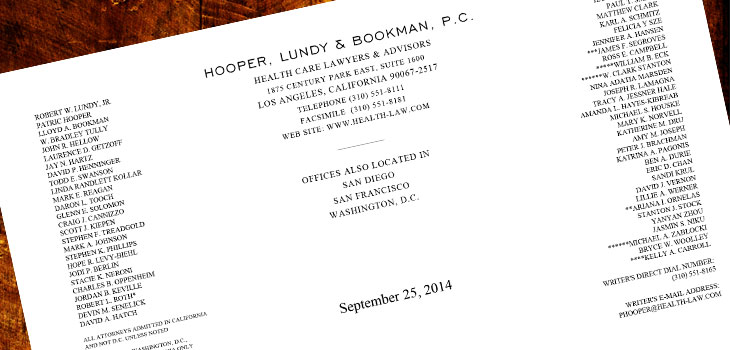
Orthopedics This Week obtained the latest salvo of fire from Patric Hooper, the defense attorney for Reliance Medical and its PODs, to the feds over his “threat” to seek sanctions against the government over their refusal to turn over an alleged conversation secretly recorded in July 2011 between his clients and potential physician investors for their PODs.
Hooper beat the U.S. Department of Justice Department (DOJ) in 1995 when the agency tried to impose the Medicare “Death Penalty” on physicians referring patients to labs they owned. The DOJ has been looking for a case ever since to get even. They found it in PODs, and once again Hooper is the attorney for the defense.
Hooper’s latest fight with the feds over physician ownership in the business of health went public and viral on September 25, 2014, when CBS Morning News sensationalized the death of a patient who had received spinal implants from a POD in which the surgeon had an ownership interest.
Hooper, citing a famous terrorist case, says even “enemy combatants” are entitled to due process rights. He says the government has been “persecuting” his clients ever since details of their investigation were leaked anonymously to the press. The former Deputy Attorney General of the State of California reminded the federal lawyers that, “we are required to do justice as opposed to trying to win a case at any cost.”
Get deep inside this latest fight over PODs.
September 25, 2014
VIA EMAIL
David M. Finkelstein
Arthur S. Di Dio
United States Department of Justice
601 D Street, NW
Washington D.C. 20004
Re: United States v. Reliance Medical Systems, et al.
Dear David and Arthur:
Thank you for your letter today in response to my email of September 22 that you characterize as being a “[threat] to seek sanctions against the United States.” You further state “this threat is part of a pattern of troubling conduct that began almost immediately after” I was retained in July 2014. You then discuss what you believe to be “a pattern of baseless accusations” by me. Before responding to these charges, let me please provide some context once again to the current situation.
Perhaps you had the opportunity to view today’s episode of “CBS This Morning” in which DOJ’s lawsuit against my clients is highlighted to a national TV audience. This publication and many others, including articles in the Wall Street Journal and health industry media, and radio broadcasts, completely demonize my clients based in large part, if not wholly, on the allegations published by DOJ in its recent press release and in the body of the complaint in this case. The alleged tape recorded conversations of July 2011 and your characterization of their contents provide the primary fodder for the media’s woefully inaccurate “description” of my clients and their conduct.
As you know, the media crusade against my clients did not begin with the filing of your lawsuit. Rather, the persecution began once your investigation started and was fueled by leaks to the media regarding the investigation. Moreover, as you obviously know, the conducting of the investigation, itself, was extremely detrimental to the reputation of my clients and their ability to earn a living and pursue an occupation. It requires no speculation to conclude that when a hospital or a doctor learns that DOJ is investigating someone who is engaged in doing business with the hospital or doctor, the hospital or doctor will be inclined to terminate the relationship to avoid being tainted by the investigation. This is especially so when counsel for DOJ essentially tell the hospitals that my clients’ activities are illegal.
Here, since the filing of the action and well before then, hospitals and doctors have stopped doing business with my clients for fear of retribution and retaliation by DOJ and damage to their own reputations. Not surprisingly, my clients’ competitors and some self-proclaimed medical “ethicists” are quite pleased by this result. The bad facts being bantered about also sell more newspapers than a more nuanced and truthful story. My clients have become pariahs in the health care industry due solely to your investigation and the charges you have made against them.
As you know, I am very familiar with the Federal Rules of Civil Procedure to which you refer in your letter regarding discovery and other procedural aspects of False Claims Act cases and are obviously prepared to proceed pursuant to such rules. However, as lawyers, especially government lawyers (and I was one many years ago), we are required to do justice as opposed to trying to win a case at any costs. Also, as you know, Constitutional provisions trump the Federal Rules of Procedure.
Here, fundamental fairness and due process of the law require that my clients be given timely notice of the evidence against them. DOJ has now possessed and selectively used the July 2011 tape recordings against my clients for more than three years. In fact, you used your characterization of their content to question my clients extensively about them under oath in March 2013 without ever giving them copies or even a transcript to review before, during, or after their testimony.
Now, your one-sided and agenda-driven characterization of their content is included in the juiciest parts of your complaint – the parts that were obviously intended primarily for the media’s consumption and publication. Yet, you still refuse to make the recordings available to me under any circumstances and instead argue that I will get them in due course under the Federal Rules of Civil Procedure – i.e., months from now – even though my clients’ liberty and property interests are continuing to be damaged and have been damaged for some time now.
I am certain you must know that Due Process of the Law prohibits the government from depriving a person of property or liberty absent timely notice and an opportunity to be heard regarding charges of the type here. DOJ’s contentions based on the tapes have been destroying my clients’ businesses and reputations for a long time now without the content being made known to my clients. Even “enemy combatants” are entitled to due process rights greater than that which have been given my clients under the circumstances here. See Hamdi v. Rumsfeld, 542 U.S. 507 (2004) where the Court determined the rights of enemy combatants under Due Process Clause of the Fifth Amendment, among other laws. We once again demand to see the tapes immediately.[1]
As to my “baseless accusations, ” please let me remind you that my earlier speculation was correct about the pendency of a qui tam action even though I was mistaken about the relator. Moreover, it is apparent that you did not need any further information from my clients in July 2014 to complete your investigation confirming that my position rejecting your request for information (in addition to the 168, 000 pages of documents already produced) was correct.
As to the allegations in paragraph 91 of the complaint, please produce the evidence in your possession that you contend supports them since my clients deny the truth of the allegations. I am trying to avoid filing a Rule 11 motion. Finally, I continue to stand by my other “accusations.”[2]
Very truly yours,
Patric Hooper
PH/PH
Jonathan Frank (via email)
[1] As you know, under California Law, Penal Code Section 632 and others, tape recording a confidential conversation without the consent of all parties is a crime, and the content of such a recording is inadmissible in any court proceeding. We know there is an exception for law enforcement and assume that there was duly authorized involvement of law enforcement here but are beginning to question that assumption in light of your continued withholding of the tape recordings.
[2] I abide by the Central District’s “Civility and Professionalism Guidelines.” In my opinion ex parte discussions with other counsel in this case, such as your recent discussion with Mr. Frank, and your refusal to disclose the tape recordings until the federal rules purportedly require them to be disclosed are inconsistent with these guidelines.
Author
React:
Discussion
This is a fascinating development. In my practice we've seen similar outcomes with the revised protocol. The key differentiator seems to be patient selection criteria. Has anyone else noticed the correlation with BMI thresholds?
Great point. I'd push back slightly on the conclusion, the sample size in the cited study is too small to draw population-level inferences. That said, the directional signal is compelling and worth a larger RCT.
We implemented a similar approach last year. Early results are promising but we're still gathering 12-month follow-up data. Happy to share our protocol if anyone is interested.
Join the conversation
Orthopedic professionals are discussing this. Sign in and upgrade to read every comment and add your voice.