
By working with CTSK (Cathepsin K), one of the enzymes used to resorb bone, researchers from Johns Hopkins have found that a group of “scientifically overlooked” cells could be crucial to the process of bone loss caused by osteoporosis. The researchers say that the cells, known as preosteoclasts, also explain the success and activity of an experimental osteoporosis drug—odanacatib.
Overlooked Cells May be Clue to Osteoporosis
2 min read Premium comments
Secondary
“We didn’t know that the drug affects preosteoclasts, nor did we understand how important preosteoclasts are in maintaining healthy bones, ” says Xu Cao, Ph.D., the Lee H. Riley Jr., M.D., Professor of Orthopaedic Surgery, in the October 6, 2014 news release. “Now drug companies hoping to reverse osteoporosis can look for even more drugs that make use of and target these interesting cells.”
Earlier studies had already demonstrated that using the drug odanacatib results in decreased bone resorption by hobbling CTSK. In the current study, odanacatib proved itself as capable of increasing the rebuilding of bone.
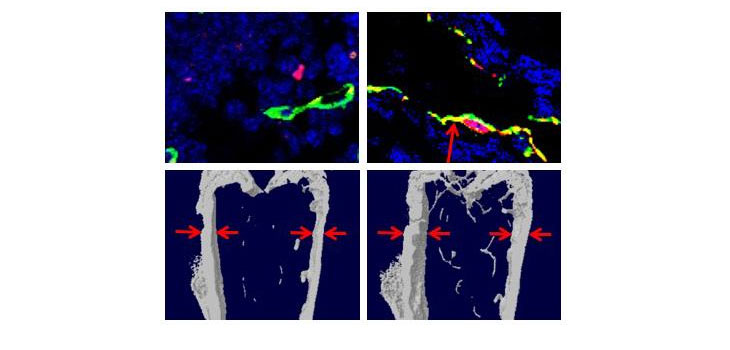
To learn how it did this, mice were engineered to have neither bone-dissolving osteoclasts nor preosteoclasts. The team found that the inner layers bones of the mice were abnormal (as they had expected them to be), and that the outside layers of the bones were thin. “Moreover, the specialized blood vessels needed to transport bone-building supplies were in scarce supply, suggesting overall that osteoclasts and their precursors regulate bone building and bone resorption.”
“The team grew the two cell types separately in the laboratory and collected the liquid around them to test for proteins released by the cells. They found that preosteoclasts—but not mature osteoclasts—secrete a protein called PDGF-BB [platelet derived growth factor], which is a powerful attracter both of cells that make bone-building cells and those that make the specialized blood vessels. As expected, when the preosteoclasts of mice were prevented from making PDGF-BB, the mice had weak bones.”
Dosing the mice with odanacatib resulted in an increase in preosteoclasts and osteoclasts; they also secreted more PDGF-BB. “The increased PDGF-BB brought in more cells for making blood vessels and bone, which led to more of the specialized blood vessels and thicker bones.”
“To see if the drug could help reverse the increased bone resorption and decreased blood vessel formation of postmenopausal osteoporosis, the researchers simulated menopause in female mice by removing their ovaries. At first, the mice had thinner bones and fewer blood vessels, but treatment with the drug increased the concentration of PDGF-BB in the blood, the number of specialized blood vessels both inside and outside of the bones, and the overall thickness and density of the bone.”
Author
React:
Discussion
This is a fascinating development. In my practice we've seen similar outcomes with the revised protocol. The key differentiator seems to be patient selection criteria. Has anyone else noticed the correlation with BMI thresholds?
Great point. I'd push back slightly on the conclusion, the sample size in the cited study is too small to draw population-level inferences. That said, the directional signal is compelling and worth a larger RCT.
We implemented a similar approach last year. Early results are promising but we're still gathering 12-month follow-up data. Happy to share our protocol if anyone is interested.
Join the conversation
Orthopedic professionals are discussing this. Sign in and upgrade to read every comment and add your voice.