
Brown University researchers have found a new way of extracting bone-producing cells from human fat, even developing a fluorescent tag that could locate and identify cells expressing the gene known as ALPL (alkaline phosphatase). If the tag finds the RNA (ribonucleic acid) produced when the gene is expressed, it attaches and glows.
Novel Way to Get Bone-Producing Cells From Fat
2 min read Premium comments
Secondary
Hetal Marble, lead author and Brown graduate student, said in the October 6, 2014 news release “targeting gene expression rather than surface proteins for the purpose of gathering cells to make a new tissue is a ‘paradigm shift’ in the following regard: Gene expression provides a way to target any cell based on whether it can produce another tissue, while targeting surface proteins limits researchers to harvesting cells that fit a presumed definition of being a stem cell. The new approach, she said, is more pragmatic for the purpose.”
The team had a four-day wait period because that’s how long it takes for the maximum number of cells to express ALPL when cells are chemically primed to do so. In future research, said senior author Eric Darling, Ph.D., the Manning Assistant Professor of Molecular Pharmacology, Physiology and Biotechnology and a member of the Center for Biomedical Engineering assistant professor of medical science, the team would like to target a gene expressed much earlier in the differentiation process to see if they can avoid a priming period.
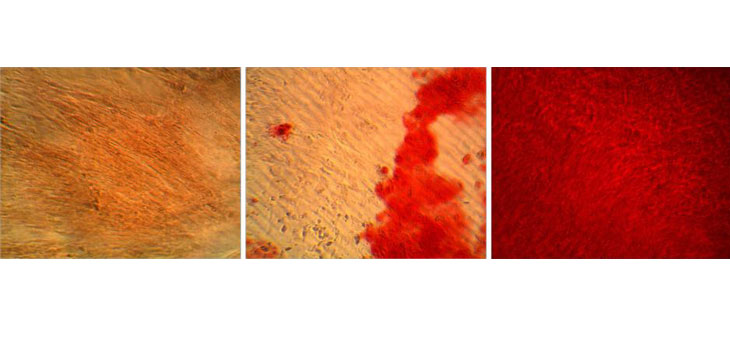
Asked what should orthopedic surgeons know about this work, Dr. Darling commented to OTW, “The effectiveness of cell-based therapies depends to a great extent on the quality of the cell population used. If you treat a bone defect with cells incapable of producing bone, your outcomes will be poor. Mesenchymal stem/stromal cell populations include many different cell types. Our work showed that a fluorescent marker could be used to identify which cells could positively express a gene associated with bone, and in combination with a fluorescence-activated cell sorter, could enrich for bone-forming cells. Enriched cells were shown to deposit up to eight-times more calcified matrix than unsorted cells, which is hypothesized to translate into quicker and/or stronger tissue formation. The fluorescent marker degrades and has no effect on the differentiation capability or viability of treated cells. The cell yield was also much higher than conventional approaches, which moves us closer to our eventual goal of making single-surgery procedures possible, i.e., autologous cells taken from a patient, purified, and re-implanted within one surgical session.”
He added, “The techniques used in this study could theoretically be used to sort cells based on the expression of any gene (mRNA [messenger RNA], actually). We targeted alkaline phosphatase, liver/bone/kidney (ALPL gene), which is expressed soon after stem cells are exposed to chemicals that induce osteogenesis. It should be possible to target earlier genes in the osteogenic differentiation cascade, although further work would need to be done to determine whether there is a sufficient difference in expression between cells that can and cannot differentiate along that lineage. Genomic studies can help in identifying highly expressed genes that should be targeted, with empirical measurements being the ultimate decider on whether sorting/enrichment produces an increase in ostegenesis while not compromising cell yield to a great extent.”
React:
Discussion
This is a fascinating development. In my practice we've seen similar outcomes with the revised protocol. The key differentiator seems to be patient selection criteria. Has anyone else noticed the correlation with BMI thresholds?
Great point. I'd push back slightly on the conclusion, the sample size in the cited study is too small to draw population-level inferences. That said, the directional signal is compelling and worth a larger RCT.
We implemented a similar approach last year. Early results are promising but we're still gathering 12-month follow-up data. Happy to share our protocol if anyone is interested.
Join the conversation
Orthopedic professionals are discussing this. Sign in and upgrade to read every comment and add your voice.