
Over the past ten years, PEEK (polyetheretherketone) has largely replaced titanium as the material of choice for orthopedic implants.
Medtronic Coats Titanium to PEEK for New Spine Implants
2 min read Premium comments
Secondary
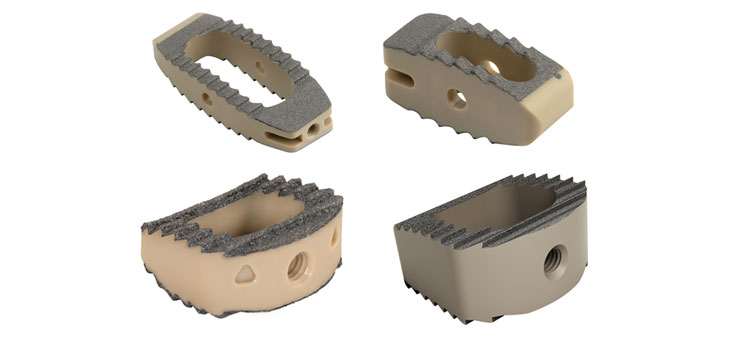
But now, Medtronic, Inc. is marrying the two materials together, calling it an “evolution in interbody fusion technology” by constructing devices made with a combination of the two materials in a “Pure Titanium Coating” (PTC) platform. The company applies a thin layer of textured pure titanium about 1/10th of a millimeter thick to the top and bottom of each four different PEEK implants. The implants include two spinal systems, a PEEK cervical fusion system and a cervical cage.
The company introduced the new platform on October 20, 2014 at the Congress of Neurological Surgeons (CNS) Annual Meeting in Boston.
“Surgeons, ” according to the company, “have historically preferred interbody spacers made of titanium because of their strength and long clinical history.” But PEEK “replaced titanium because it has a modulus of elasticity that is similar to human cortical bone and it does not show up on X-rays. This radiolucency lets the surgeon assess the surgical site more easily after surgery.”
The company says that mechanical testing has shown that compared to PEEK alone, the pure titanium coating has a greater coefficient of friction. “Additionally, this textured coating increases the surface area of the implant, which means there is more area for bone to come into contact with the surface of the implant. Yet, the titanium layer is thin enough that it does not change the radiolucency or mechanical properties of the underlying PEEK implant, ” said the company statement.
The four products in the company’s new PTC platform include:
FDA 510(k) clearance for the Capstone and Clydesdale spinal systems was received in March and the products were launched in the U.S. in August. Both systems received CE Mark (Conformité Européenne) in July. The Capstone was launched in Western Europe in September and is expected to be launched in Japan in November 2015. The Clydesdale launch in Japan is projected to be in January 2016.
FDA 510(k) clearance was received for the Anatomic PEEK PTC cervical fusion system, which was launched in the U.S. in September.
CE Mark for the Cornerstone-SR Ti-Coated anatomical cervical cage has been received and the product—not for use in the U.S. or its territories—launched in Western Europe in July.
Doug King, president of Medtronic’s spine business and senior VP at Medtronic, said, “Our PTC platform of interbody spacers is the result of our relentless effort to add value to our products and respond to surgeon needs by offering the advantages of combined materials in a single implant. We will continue to leverage our innovation to produce more advanced and differentiated products for surgeons to use to treat their patients.”
Author
React:
Discussion
This is a fascinating development. In my practice we've seen similar outcomes with the revised protocol. The key differentiator seems to be patient selection criteria. Has anyone else noticed the correlation with BMI thresholds?
Great point. I'd push back slightly on the conclusion, the sample size in the cited study is too small to draw population-level inferences. That said, the directional signal is compelling and worth a larger RCT.
We implemented a similar approach last year. Early results are promising but we're still gathering 12-month follow-up data. Happy to share our protocol if anyone is interested.
Join the conversation
Orthopedic professionals are discussing this. Sign in and upgrade to read every comment and add your voice.