
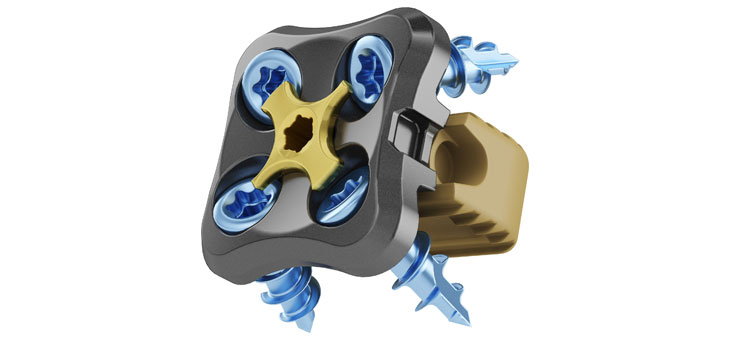
Medtronic, Inc. has launched a new anterior fusion system that the company says makes the ACDF (anterior cervical discectomy with fusion) procedure more efficient for the surgeon and less invasive for the patient.
Medtronic Claims Better Anterior Cervical Fusion System
2 min read Premium comments
Secondary
The Divergence system had its U.S. launch on October 21, 2014 at the Congress of Neurological Surgeons (CNS) Annual Meeting in Boston.
Traditional one-level ACDF procedures use a four-hour plate and interbody fusion cage. With the Divergence system, the company says the plate and interbody cage can be inserted simultaneously using a common set of instrumentation and one surgical technique. Traditional cervical fusion surgery requires a two-step insertion technique for the plate and interbody cage, and each implant requires its own set of instruments and its own surgical technique.
The system, according to the company, also incorporates a laterally-divergent screw insertion technique, which requires less retraction compared to the traditional medially-convergent screw insertion techniques used with other anterior cervical plating systems.
The company cited a 2013 issue of The Spine Journal, where Dong-Ho Lee, M.D., and colleagues published an article entitled “Anterior Cervical Plating Technique to Prevent Adjacent-Level Ossification Development.” The study, says the company, concluded that ACDF patients with plates placed less than 5mm from the adjacent level disc have statistically significant increases in the frequency and severity of adjacent-level ossification disease (ALOD), a condition in which osteophytes (bone spurs) develop at the adjacent level and may become symptomatic. “The article also demonstrated that short plates allow for increased screw angulation, longer screw placement, reduced incision size, minimized dissection of the anterior longitudinal ligament (ALL) and limited encroachment by the plate on adjacent-level discs, ” added the company announcement.
The new system’s plates are offered in relatively short lengths of 15.5mm to 20.5mm, and are designed for use with hyper-angulated screw insertion techniques.
According to the company announcement, the system’s plate and bone screw components are intended for anterior interbody screw fixation from C2-T1. “The components are indicated for use in the temporary stabilization of the anterior spine during the development of spinal fusions in patients with:
- degenerative disc disease (as defined by neck pain of discogenic origin with degeneration of the disc confirmed by patient history and radiographic studies)
- trauma (including fractures)
- tumors
- deformity (defined as kyphosis, lordosis, or scoliosis)
- pseudoarthrosis
- failed previous fusions.”
Author
React:
Discussion
This is a fascinating development. In my practice we've seen similar outcomes with the revised protocol. The key differentiator seems to be patient selection criteria. Has anyone else noticed the correlation with BMI thresholds?
Great point. I'd push back slightly on the conclusion, the sample size in the cited study is too small to draw population-level inferences. That said, the directional signal is compelling and worth a larger RCT.
We implemented a similar approach last year. Early results are promising but we're still gathering 12-month follow-up data. Happy to share our protocol if anyone is interested.
Join the conversation
Orthopedic professionals are discussing this. Sign in and upgrade to read every comment and add your voice.