
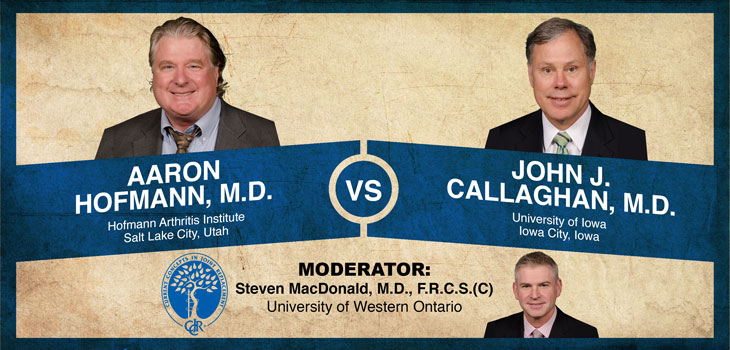
This week’s Orthopaedic Crossfire® debate is “The Posterior Stabilized Knee: No Post Required.” For the proposition is Aaron Hofmann, M.D. of the Hofmann Arthritis Institute in Salt Lake City, Utah. Against the proposition is John J. Callaghan, M.D. of the University of Iowa. Moderating is Steven MacDonald, M.D., F.R.C.S.(C) of the University of Western Ontario.
Hofmann, Callaghan Debate the Posterior Stabilized Knee
7 min read Premium comments
Great Debates
Dr. Hofmann: “I used to drink this Kool-Aid—saving the posterior cruciate on every patient—but I got over that and I did some cruciate saving and some cruciate sacrificing. I was a maniac about how to do it. We used a fourth-inch osteotome, placed it in front of the posterior cruciate ligament [PCL] to ensure that we didn’t cut it. Then I began agreeing with Dr. Insall, who said, ‘Exact tensioning of the PCL is often difficult and to some extent depends on luck…’”
“About 3% of the patients whose PCL I saved lost function of the PCL. Posterior substitution seemed to be the logical thing because of better operative exposure, easy balancing of the collaterals, reduced poly wear, greater contact area, and lower normal forces (Scuderi, Insall, Clinical Orthopaedics and Related Research, 1992). I began agreeing with that to the point where I designed one, but there are problems with these things.”
“In 1982 Insall found an 11% patella stress fracture rate; in 1993 Lombardi noted stress fractures, and in 1989 Hozack found patella clunk. These are old references, but we’re fooling ourselves if we think that this has gone away completely.”
“I saw a patient last year with a dislocation and flexion instability who had an anesthetic reduction in the OR because you can’t get these posts back sometimes. As for patella clunk, our cutouts on the implants have gotten smaller and so this is less of a problem. I just operated on a patient with a patella clunk last week…and they hate the rattle! This doesn’t occur if you do a cruciate saving operation or if you use an ultracongruent insert. The latter is a deep dish poly—cruciate sacrificing—with an anterior buildup and a congruent articulation (a 1:1.2 ratio between the femur and the tibia) and there’s no box cut needed.”
“When I visited Australia I was inspired by the horseback riders. Their saddle doesn’t have a saddle horn; it has a congruent surface and the ultracongruent poly does exactly the same thing. In 1991 Dr. A. Seth Greenwald did a study showing that if the strength of the PCL is 350 pounds, then the ultracongruent design is above that. There are at least seven companies that have copied this.”
“In 2006 Brian Parsley published work comparing PS [posterior stabilized] to ultra (both sacrificing the posterior cruciate ligament). It was on 219 knees and they found equal results, but improved range of motion (ROM), function, and satisfaction in the patients that had the ultracongruent version.”
“In 2012 Lombardi reported on 312 knees that were ‘anterior stabilized’ (an ultracongruent type of dished component with the highest ROM and the lowest manipulation). They found that the posterior stabilizing post is not required. Chris Peters from the University of Utah recently presented findings showing no difference between deep dished, ultracongruent and cruciate retaining (CR) designs. If you have a PCL that’s absent during the operation you can put this in and be assured that you’re going to have a stable articulation. You can get great stability just from the conformity of the poly against the femoral component.”
Dr. Callaghan: “I know Aaron Hofmann…and I know that when he rides a horse he uses a saddle with a horn! So why would he think he should put a knee replacement in without one?”
“I looked up ultracongruent liners on PubMed. I looked up ‘Hofmann ultracongruent liners’ and found one liner in 2000…so I don’t have enough ammunition. So then I searched on ‘ultracongruent insert and total knee replacement’ and I saw two old references. Then I did ‘Hofmann and deep dish’ and found a couple of references there. If you search on ‘posterior stabilized total knee’ there are over 500 references. I felt a little behind the eight ball, but I’m going to catch up.”
“We know there is mobility without congruity in CR knees. Others have shown that you can have congruity, but there is potential for high stresses at the next interface down. If you were going to use this concept on a mobile bearing I could understand it because you can get the low contact stress as well as low constraint forces.”
“I’m not going to tell you that you can’t use a conforming surface. We have reported on our LCS (low contact stress) rotating knees; you remove the cruciate and it’s a very conforming surface with no post. But the average motion in those knees was only 105 degrees. The knee needs rollback into order to get motion. On the medial side you actually pivot until you get back into flexion and then you start rolling back—on the lateral side you roll back throughout (Freeman et al., Clinical Orthopaedics and Related Research, 2003 as well as the Journal of Bone and Joint Surgery).”
“There has been a lot of work done on deep flexion of the knees with fluoroscopic modeling techniques by Rick Komistek. He showed me what happens with the ultracongruent; it stays right in the middle of the dish and that’s why you can’t get the motion that you can get if you have rollback.”
“There isn’t much on ultracongruent liners in the registries, but the American Orthopaedic Association (AOA) registry shows that there’s not much difference between PS and CR. But in the most recent meta-analysis (Bercik et al., Journal of Arthroplasty, 2013) ROM was better with the PS design. Chit Ranawat has had excellent results, both clinically as well as functionally…95% satisfaction rate with a mobile bearing PS type of knee. At minimum 10 year follow-up there were no revisions. This is similar to our LCS data, but Chit reported an average ROM of 119 degrees. That’s because the PS post gives you rollback.”
“But there are problems with PS designs. Aaron alluded to the fact that the cam post can impinge, which causes backside wear issues. You do get patella clunk. In another series (Hart, et al., Knee, 2008) there was a 1.2% prevalence. Those done arthroscopically (one debridement) had a 79% success rate; those with two debridements had a 95% success rate.”
“As Aaron noted, it’s somewhat related to the box. You want a long patellofemoral groove; most of the newer devices have these. So, good is the enemy of great. And Aaron, ultracongruent is good, but PS is great.”
Moderator MacDonald: “John, do you think in general that a PS knee gets better flexion than a CR knee?”
Dr. Callaghan: “In general, probably so. In the beginning of my career I used a lot of CR knees and in general they did well. But whenever I had a problem with motion I was concerned about whether I did it right. I’m kind of a ‘slop in the system’ guy, and I think the PS is slop in the system—to make sure that at least one technical aspect of the operation isn’t important.”
Moderator MacDonald: “Aaron, do you think it’s more reproducible to release the PCL?”
Dr. Hofmann: “I don’t think I’ve saved a PCL in the last five years. It’s more difficult, less predictable. It’s more forgiving to take the PCL; every time I train a fellow they leave my umbrella of care and then start doing ultracongruents on every single patient.”
Moderator MacDonald: “John, the registry data shows a slightly higher revision rate for PS over CR knees.”
Dr. Callaghan: “Early on you do see a few clunks, etc., and you probably do have a couple of reoperations. Some of the early designs were related to that. It shouldn’t be instability.”
Dr. Hofmann: “We all have some patients with instability; I think a PS knee is less forgiving if you get flexion instability because they get the rattle, then the post wear. I’ve seen many patients that don’t have a PCL. They thought it was saved—and they have some flexion instability—but the patients don’t really know it.”
Dr. Callaghan: “Aaron, I think that today, most of us need a tight flexion gap when you’re doing a PS knee. Some people left them relatively loose because they thought the peg would help with that, but it doesn’t.”
Moderator MacDonald: “Aaron, John pointed out that the post has a role kinematically. Do you agree?”
Dr. Hofmann: “I mostly agree. The guys that have the best deep dished poly have put the null point—the center of rotation—not in the center, but about 6mm back toward the posterior side. So you’re actually rolled back a little to start with. Then you remove the posterior lip of the ultracongruent so that it doesn’t cause impingement. One of the available implants even professes to be high flex (beyond 125 degrees).”
Moderator MacDonald: “John, you believe the post has a role?”
Dr. Callaghan: “It’s been shown—not promoted. If you don’t have a post then it’s questionable as to whether you can get rollback.”
Moderator MacDonald: “Do you ever use a true PS with a post in your primaries?”
Dr. Hofmann: “No, I use it on every revision—either a big or a little post—but not on a primary.”
Moderator MacDonald: “Thank you gentlemen.”
Please visit www.CCJR.com to register for the 2014 CCJR Winter Meeting, December 10 – 13 in Orlando.
Author
React:
Discussion
This is a fascinating development. In my practice we've seen similar outcomes with the revised protocol. The key differentiator seems to be patient selection criteria. Has anyone else noticed the correlation with BMI thresholds?
Great point. I'd push back slightly on the conclusion, the sample size in the cited study is too small to draw population-level inferences. That said, the directional signal is compelling and worth a larger RCT.
We implemented a similar approach last year. Early results are promising but we're still gathering 12-month follow-up data. Happy to share our protocol if anyone is interested.
Join the conversation
Orthopedic professionals are discussing this. Sign in and upgrade to read every comment and add your voice.