
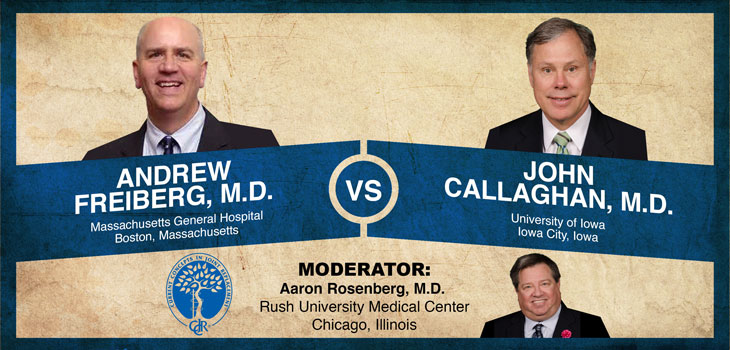
This week’s Orthopaedic Crossfire® debate is “Contemporary UHMWPE’s: All Our Burdens Now Over.” For the proposition is Andrew Freiberg, M.D. of Massachusetts General Hospital (MGH). Against the proposition is John Callaghan, M.D. of the University of Iowa. Moderating is Aaron Rosenberg, M.D. from Rush University Medical Center.
Freiberg v. Callaghan: Three Rounds Over Hip Bearing Alternatives
7 min read Premium comments
Great Debates
Dr. Freiberg: “I’ll open by saying that I think highly crosslinked polyethylenes (HXLPEs) are the most significant advance in arthroplasty this decade. They have dramatically decreased revision rates, allowed younger, more active patients to have surgery, dramatically altered the revision for osteolysis and wear, and eliminated liner exchanges. And it’s given perhaps millions of patients lifetime procedures.”
“It was only about a decade ago that we would see retrievals such as hips with adhesive and abrasive wear with early failure, with adhesive and abrasive delamination wear in the knee…with the common problems being osteolysis, implant loosening, and failure. Poly wear in a patient with conventional polyethylene limited patients’ activity and caused early failure with bone loss and osteolysis.”
“By studying retrievals we came to understand how hip and knee replacements wear. The concept of crosslinking came from using this type of scanning micrograph that shows surface changes where there are these fibrils of material that could be pulled off the surface. So the idea was to make the surface more resistant to this type of wear and debris generation. Crosslinking binds the amorphous regions to the sort of ‘spaghetti’ parts between the ladders of the lamellae to make the material more resistant to wear as well as durable enough to handle third body debris.”
“I’m guessing that Dr. Callaghan will tell you that HXLPE is new, and that the long term results are not known. (not true) He will say that crosslinked polyethylenes have inferior properties and that this can lead to failure. (that is extremely rare) And I think that John needs something other to do in retirement than garden.”
“One study looking at the long term success of crosslinked bearing surfaces—a randomized level 1 clinical trial—found that at seven years the mean steady state wear rate was .005mm/year. (Thomas EG, et al, JBJS[Am], 2011) The early bedding in/creep of the material was a bit higher in crosslinked surfaces; the wear rate, however, was extremely low.”
“Regarding RSA (radiostereometric analysis) techniques, when using the Longevity (36mm heads), out to 10 years we had very low wear rates. In our patients with a vitamin E type liner (32mm heads), out to five years, we found that the early bedding in is a bit lower, but the wear rate is the same as other melt-irradiated bearings—extremely low in the long term. At MGH there has not been a single revision for wear or osteolysis using crosslinked bearing surfaces.”
“The Australian registry shows that there is a difference (in matched patients) between those with metal and crosslinked bearings or metal and non-crosslinked, with the crosslinked patients having a much lower revision rate. This is because the conventional polyethylene patients have a much higher rate of wear and loosening as a cause of revision surgery; it begins at around four or five years postop.”
“If we look at the traditional pathways for crosslinked polyethylene market introduction, we see that these materials have usually been first introduced to the hip. This is because it’s easier to measure wear, because RSA can show if there is any effect on fixation, and because the wear environment is less harsh than in a total knee arthroplasty (TKA). When introducing these into TKA we are more dependent on wear simulators and registry data.”
“If you examine total knee data from the Australian registry in a single knee system—the only difference being the bearing surface—there is a dramatic difference in long term revision rate between the crosslinked and conventional bearings. The reason for revision in the conventional bearings is aseptic lysis from poly debris.”
“As for fatigue and fracture toughness; depending on how the material is tested (and what material is used), some of the crosslinked bearings can have decreased strength compared to conventional materials. These liner fractures are due to component malposition and are quite rare.”
Dr. Callaghan: “I’m not here to debate that HXLPEs have not provided a tremendous improvement in bearing surface wear of total hip arthroplasty (THA) constructs, especially in the first decade. But, with good THA and TKA design and gamma irradiated in air polyethylene, the first decade is not where we see problems related to wear. We did a 35-year study of the hip and a 20-year study of the knee; with both it was in the second decade that problems started to occur.”
“Our own data is very good for HXLPE; 5 Mrad re-melt, somewhere around 0.04mm/year with 28mm heads and a steady state wear rate of 0.04mm/year. And in those first two years there is a lot of creep. In our under 50 patients it was exactly the same as our older patients.”
“So there have been great improvements over what we had, but they’re not perfect. My concerns about the future are that the second decade is when wear issues become clinical issues. These issues are fracture; wear with larger heads, frictional torque, and use of polyethylene in knees (where we don’t have much data). McKellop pointed out years ago that you should keep wear rates below 0.1mm, and that if you do that, you’ll have a good chance of avoiding osteolysis.”
“There’s no question that the more you radiate that polyethylene, the lower the wear rate. But as Andy indicated, even with just a 5 Mrad re-melt you decrease the initial strength of that material. Dr. Seth Greenwald has pointed out that it’s not really the dome in the wear area, it’s that these capturing mechanisms on the edges have high stresses…and if you have a material that is at all weak, then that’s where you’ll see the problems.”
“As Andy has pointed out, some of it is related to technique. Roy Crowninshield and Bill Maloney found that the more vertical the cup you put in, the higher the stresses. But indeed they occur, and components that are malpositioned can have the same problems as the hard bearings.”
“Regarding the head size issue, in wear simulator studies there is still a higher wear rate with HXLPE when compared to the controls. And that’s just the tribology of sliding distance…it’s going to happen. Lachiewicz has just shown with a 10 Mrad polyethylene and larger head sizes he saw more wear. And just as of September 2014 Lachiewicz found that he had 14% small osteolytic lesions associated with larger heads.”
“We know that there’s re-melt and annealing; the problem with the latter is that you reduce the free radicals, but you still leave some. And because some remain there may be oxidation. There is data to support this. However, you’re also seeing this occur with re-melted polyethylene, which takes out the free radicals. Andy’s own group has shown that lipids can diffuse into those regions, however, cyclic loading can also cause oxidation; we are seeing some oxidation in retrievals. With vitamin E there’s no question that you can keep the strength while still getting the crosslinking.”
“The one thing that’s raised its head with crosslinking is that you might have increased frictional torque, which may be related to the trunion issues we are seeing. Recently, Menenghini has shown that with vitamin E there is substantial increase in torque. In the knee we have only one study, and that’s where the capturing mechanisms might be the biggest problem.”
Dr. Freiberg: “The two pictures you showed on strength and risk of liner fracture, well, John, I’ve seen everywhere in the world. I think the incidence of that is really at the case report level. Then there is lipid absorption and changes in crosslinked density that may occur on the surface of some of the crosslinked bearing surfaces. I think that’s a real phenomenon; the question is, ‘Does it affect wear rate?’ You might have lipid or squalene absorption, oxidation, or changes in crosslinked density. But in our RSA studies we haven’t seen any increase in wear rate at the midterm.”
“As for frictional torque, I’ll take issue with what you said about a ‘dramatic’ difference in frictional rotation because it’s my understanding that the data show 8.5 or 9.5 rotations versus 11 on a pendulum comparator.”
Moderator Rosenberg: “Dr. Callaghan?”
Dr. Callaghan: “Fracture remains a concern, and I agree that we don’t even know how much frictional torque would have an effect on the trunion…and then there is the oxidation issue.”
Moderator Rosenberg: “There is still concern about bigger head sizes showing variation in the results in terms of the amount of wear. Andy?”
Dr. Freiberg: “If you step back and look at head size there are two issues. One is wear and the other is the effect on the trunion. If I go to a 36mm head I use a ceramic head. For a 32mm head I do it by age.”
Moderator Rosenberg: “What are your age cutoffs?”
Dr. Freiberg: “John’s age.”
Moderator Rosenberg: “John?”
Dr. Callaghan: “I try to stay 32mm and below; the older the patient the more I will go up. As you go to 36mm, some of the manufacturers will let you use very thin poly out at the edge, which concerns me. And the larger heads are going to wear a bit more than the smaller heads.”
Moderator Rosenberg: “The recent claim that vitamin E increases the frictional torque makes me nervous because that wasn’t on anyone’s radar screen. So I wonder how much of a clinical track record would you hope to have before you can recommend switching from a HXLPE that’s working well to a new poly that MAY be better?”
Dr. Freiberg: “It’s our duty to study these materials, so I think it depends on what the clinician is comfortable with.”
Moderator Rosenberg: “Thank you, gentlemen.”
Please visit www.CCJR.com to register for the 2014 CCJR Winter Meeting, December 10 – 13 in Orlando.
Author
React:
Discussion
This is a fascinating development. In my practice we've seen similar outcomes with the revised protocol. The key differentiator seems to be patient selection criteria. Has anyone else noticed the correlation with BMI thresholds?
Great point. I'd push back slightly on the conclusion, the sample size in the cited study is too small to draw population-level inferences. That said, the directional signal is compelling and worth a larger RCT.
We implemented a similar approach last year. Early results are promising but we're still gathering 12-month follow-up data. Happy to share our protocol if anyone is interested.
Join the conversation
Orthopedic professionals are discussing this. Sign in and upgrade to read every comment and add your voice.