
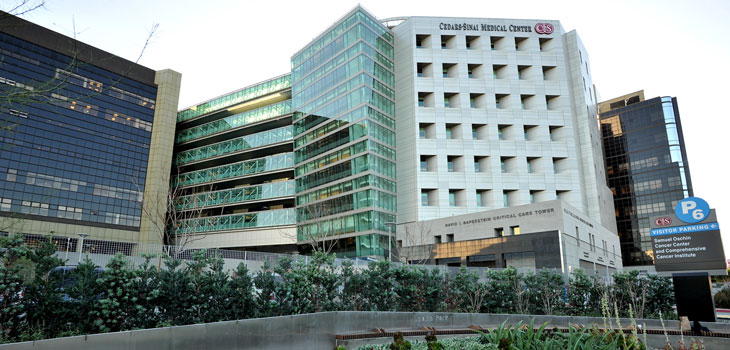
There’s a new orthopedic triumvirate in Southern California these days. Cedars-Sinai Health System has just announced an agreement with the Institute for Sports Sciences that clears the way for a formal affiliation with the Kerlan-Jobe Orthopaedic Clinic and Santa Monica Orthopaedic and Sports Medicine Group.
Cedars-Sinai Now Affiliated With Kerlan-Jobe, Santa Monica Orthopaedic and Sports Medicine
2 min read Premium comments
Secondary
In 2014, the Institute for Sports Sciences was formed by Kerlan-Jobe and Santa Monica Orthopaedic and Sports Medicine Group so that together these high level entities could work toward innovative clinical, research and training programs in sports medicine and orthopedics. Last year, the Institute for Sports Sciences announced that it had selected Cedars-Sinai as a partner in these efforts. Going forward, the Institute for Sports Sciences will continue to manage Kerlan-Jobe and Santa Monica Orthopaedic and Sports Medicine Group.
“Cedars-Sinai’s orthopedic program is already ranked as the best in the West and is in the top 10 nationally, so when we partner with such outstanding orthopedic groups as Kerlan-Jobe and Santa Monica Orthopaedic and Sports Medicine, the possibilities for taking orthopedics and sports medicine to an unprecedented new level for patients are extraordinary, ” said Thomas M. Priselac, president and CEO of Cedars-Sinai, in the October 8, 2014 news release.
“The Institute for Sports Sciences represents a new model for how physician specialists in different groups can come together and help shape the healthcare landscape in some very impactful ways, ” said Jeremy Hogue, CEO of the Institute for Sports Sciences.
Bert Mandelbaum, M.D., chair of the Santa Monica Orthopaedic and Sports Medicine Group Foundation, and head of its fellowship program, told OTW, “We have a lot of parts to our overall enterprise, and we have some exciting priorities within each domain. From a clinic standpoint, we will be adding physicians and groups which are a good match to our culture and share our mission and vision. From a surgery center standpoint, we are looking to add service lines like outpatient spine and joint replacement, as well as look to expand to other surgery centers. And from a research standpoint, the partnership with Cedars-Sinai, which is one of the premier research hospitals in the world, is really exciting as we take advantage of this combination and work on some game-changing developments.”
Neal ElAttrache, M.D., chair of the Kerlan-Jobe Orthopaedic Foundation and head of its fellowship program, commented to OTW, “And one overriding priority is to truly integrate our organizations so that—while they remain separate in ways that are good for each group—we ensure that our leadership and strategic planning is part of a singular focus and we truly take advantage of the collective strength we have assembled. The long-term goals for this partnership are very big and bold, but also very attainable. It’s exciting to see the way our leadership is already coming together to ensure we meet our potential.”
Author
React:
Discussion
This is a fascinating development. In my practice we've seen similar outcomes with the revised protocol. The key differentiator seems to be patient selection criteria. Has anyone else noticed the correlation with BMI thresholds?
Great point. I'd push back slightly on the conclusion, the sample size in the cited study is too small to draw population-level inferences. That said, the directional signal is compelling and worth a larger RCT.
We implemented a similar approach last year. Early results are promising but we're still gathering 12-month follow-up data. Happy to share our protocol if anyone is interested.
Join the conversation
Orthopedic professionals are discussing this. Sign in and upgrade to read every comment and add your voice.