
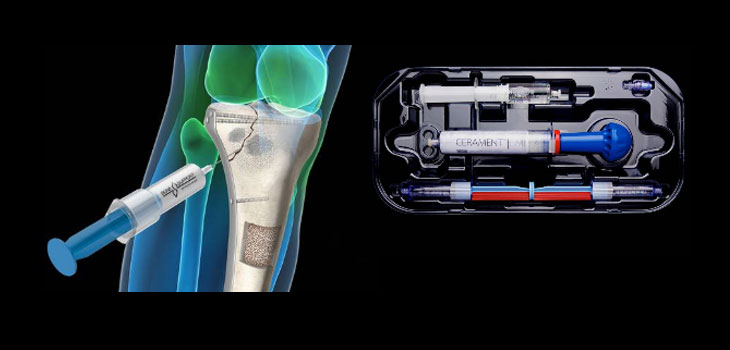
Bonesupport, a maker of injectable bone substitutes for orthopedic trauma, has reached the 12-month point for follow-up data on a clinical trial investigating the safety and efficacy of Cerament|G—used to treat chronic bone infection.
Bonesupport Aces Twelve-Month Trial
1 min read Premium comments
Secondary
The data reported on a series of 41 patients with chronic osteomyelitis present for a mean of 10.4 years. Thirty-two of the patients had undergone previous surgery. The mean follow-up time was 13.2 months. Cerament|G is the first injectable antibiotic eluting bone substitute that is indicated to promote and protect bone healing that is being jeopardized by infection, according to the release.
The results were positive. Results showed complete wound healing in all patients treated with Cerament|G, and full bone remodeling of the void in 75% of patients at six months with evidence of ongoing bone remodeling in 80% of the remaining patients.
“These clinical trial results provide important evidence and confidence for surgeons that Cerament|G provides a safe and effective delivery of antibiotics into bone defects and is an important advance in the management of chronic bone infection, ” said Martin McNally, M.D., presenter and lead surgeon of the Bone Infection Unit at the Nuffield Orthopaedic Centre in Oxford, United Kingdom.
He added, “Moreover, Cerament|G was administered in a one-stage procedure and demonstrated concomitant in-growth of new bone in many cases, with significantly low rates of infection recurrence (2.4%), wound complications and fracture rates as compared to previous published series using other absorbable carriers.”
Lloyd Diamond, CEO of Bonesupport, expressed pleasure at the 12-month study reports. “This evidence reinforces our belief that Cerament|G has the potential to impact the surgical strategy for managing osteomyelitis, by providing a more effective delivery of antibiotics with concomitant full bone healing in a one-stage procedure, thereby reducing treatment time, minimizing surgical interventions and lowering healthcare costs.”
Osteomyelitis is a $1.7 billion market where prolonged, long-term antibiotic therapy, repeated surgical interventions and the threat of amputation are the current standard of care. Rates of osteomyelitis are rising, due to infections, diabetic ulcers, war and sports injuries and antibiotic resistance.
Author
React:
Discussion
This is a fascinating development. In my practice we've seen similar outcomes with the revised protocol. The key differentiator seems to be patient selection criteria. Has anyone else noticed the correlation with BMI thresholds?
Great point. I'd push back slightly on the conclusion, the sample size in the cited study is too small to draw population-level inferences. That said, the directional signal is compelling and worth a larger RCT.
We implemented a similar approach last year. Early results are promising but we're still gathering 12-month follow-up data. Happy to share our protocol if anyone is interested.
Join the conversation
Orthopedic professionals are discussing this. Sign in and upgrade to read every comment and add your voice.