
To be eligible for the ankle replacement designed by Jonathan Deland, M.D. you must have suffered for some time with ankle pain, failed to improve with bracing or other treatments, be 50 years old or older and have good bone quality and foot alignment, according to a press release from Hospital for Special Surgery (HSS).
Ankle Replacement Prime Treatment for Pain
1 min read Premium comments
Secondary
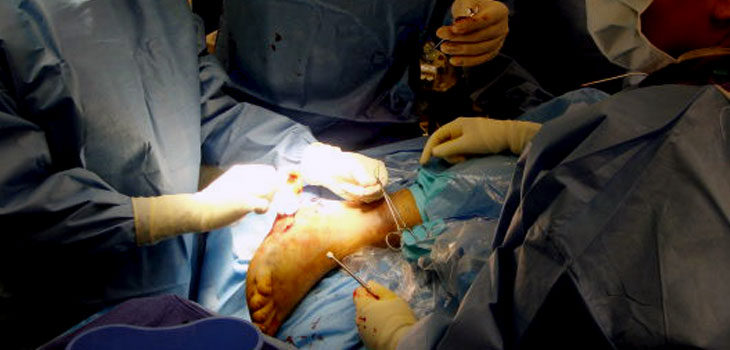
Ankle replacement is becoming a prime treatment for relief from pain, thanks to improvements in the design of the implant. As Deland explains, “In ankle replacement, we replace the damaged surfaces of the ankle joint with an artificial implant. One of the main advantages of ankle replacement is that it provides patients with better movement and mobility compared to ankle fusion, in which bones in the ankle are fused together using metal screws.”
When speaking of the design of his newest implant Deland says, “It is designed to better reproduce the ankle’s natural motion. It is also designed to be longer lasting. It has the proper curvatures like a normal ankle.”
The HSS news release notes that the surgical technique used with the new prosthesis entails an incision on the side of the ankle, as opposed to one in the front which was typically used for traditional implants. Deland says, “The side incision will generally cause less disruption to the soft tissues surrounding the ankle joint and allows for the replication of curved bone surfaces like those in a normal ankle.”
Author
React:
Discussion
This is a fascinating development. In my practice we've seen similar outcomes with the revised protocol. The key differentiator seems to be patient selection criteria. Has anyone else noticed the correlation with BMI thresholds?
Great point. I'd push back slightly on the conclusion, the sample size in the cited study is too small to draw population-level inferences. That said, the directional signal is compelling and worth a larger RCT.
We implemented a similar approach last year. Early results are promising but we're still gathering 12-month follow-up data. Happy to share our protocol if anyone is interested.
Join the conversation
Orthopedic professionals are discussing this. Sign in and upgrade to read every comment and add your voice.