
New algorithms coming out of the lab at Washington University in St. Louis could help identify weak spots in tendons, muscles and bones before there is actual tearing or breaking. The research, available online in the Journal of the Royal Society Interface, is not yet ready for use in humans.
Technology May Predict Muscle, Bone Weakness
2 min read Premium comments
Secondary
“Tendons are constantly stretching as muscles pull on them, and bones also bend or compress as we carry out everyday activities, ” said senior investigator Stavros Thomopoulos, Ph.D., professor of orthopedic surgery, in the August 26, 2014 news release. “Small cracks or tears can result from these loads and lead to major injuries. Understanding how these tears and cracks develop over time therefore is important for diagnosing and tracking injuries.”
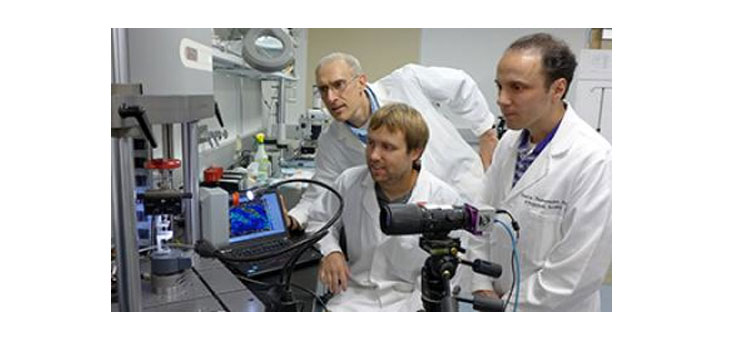
Thus, the researchers set about stretching tissues and watching what happened as they were distorted. John J. Boyle is a graduate student in biomedical engineering, and is the paper’s first author. He “combined mechanical engineering fundamentals with image-analysis techniques to create the algorithms, which were tested in different materials and in animal models.”
Boyle noted, “As you pull and stretch the plastic wrap, eventually tears begin to emerge. The new algorithm allowed us to find the places where the tears were beginning to form and to track them as they extended. Older algorithms are not as good at finding and tracking localized strains as the material stretches.”
As indicated in the news release, one of the two new algorithms is 1, 000 times more accurate than older methods at quantifying very large stretches near tiny cracks and tears, the research showed. And a second algorithm has the ability to predict where cracks and failures are likely to form.
“This extra accuracy is critical for quantifying large strains, ” said Guy Genin, Ph.D., professor of mechanical engineering and co-senior investigator on the study. “Commercial algorithms that estimate strain often are much less sensitive, and they are prone to detecting noise that can arise from the algorithm itself rather than from the material being examined. The new algorithms can distinguish the noise from true regions of large strains.”
The team says that the technology of today—MRI and ultrasound, for example—are incapable of picking up these strains.
Interestingly, Genin also explained that one day the algorithms could also help engineers identify vulnerable parts of buildings and other structures. Our muscles and bones, he said, are influenced by the same strains that affect those structures. The group has applied for a provisional patent.
React:
Discussion
This is a fascinating development. In my practice we've seen similar outcomes with the revised protocol. The key differentiator seems to be patient selection criteria. Has anyone else noticed the correlation with BMI thresholds?
Great point. I'd push back slightly on the conclusion, the sample size in the cited study is too small to draw population-level inferences. That said, the directional signal is compelling and worth a larger RCT.
We implemented a similar approach last year. Early results are promising but we're still gathering 12-month follow-up data. Happy to share our protocol if anyone is interested.
Join the conversation
Orthopedic professionals are discussing this. Sign in and upgrade to read every comment and add your voice.