
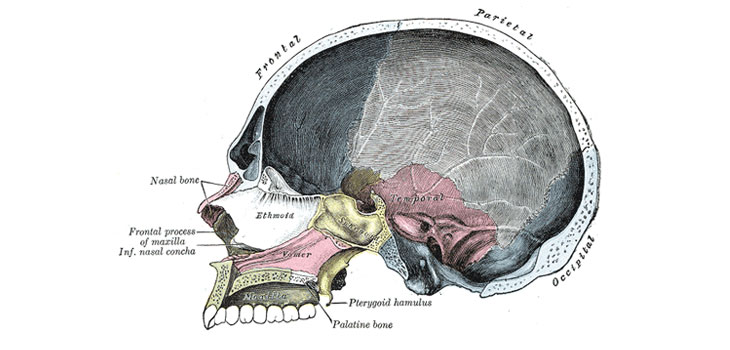
A group of surgeons in the south of India were recently confronted with a three-year-old girl suffering from a condition called craniosynostosis—a premature ossification of the bones in an infant skull where the joints between the bones fuse together in an abnormal way. Unless it was surgically corrected, the girl’s brain growth and mental development would be drastically affected.
Surgeons Practice on 3-D Printed Skull
1 min read Premium comments
Secondary
Before proceeding the doctors first conducted a CT scan and then converted it into a 3-D file, which they sent to a 3-D print maker in Mumbai. Using the additive process of a 3-D printer which melts countless thin layers of metal powder, one upon another using a laser, the company shaped a replica of the girl’s brain and her skull. It took them nine hours to complete it.
The surgeons from the Jawaharlal Institute of Postgraduate Medical Education and Research used the replica to practice on. A writer for New Tech for Old India said, “In the emerging world of 3-D printed organs, using a 3-D printed skull to practice on before as major operation may not be such a fancy thing. But in a country with so few resources, this is a giant achievement.”
The leader of the surgical team, Dinesh Kumar, M.D. said, “We would have completed the operation by now, but the girl has contracted a respiratory infection, because of which we cannot give her anesthesia.”
Author
React:
Discussion
This is a fascinating development. In my practice we've seen similar outcomes with the revised protocol. The key differentiator seems to be patient selection criteria. Has anyone else noticed the correlation with BMI thresholds?
Great point. I'd push back slightly on the conclusion, the sample size in the cited study is too small to draw population-level inferences. That said, the directional signal is compelling and worth a larger RCT.
We implemented a similar approach last year. Early results are promising but we're still gathering 12-month follow-up data. Happy to share our protocol if anyone is interested.
Join the conversation
Orthopedic professionals are discussing this. Sign in and upgrade to read every comment and add your voice.