
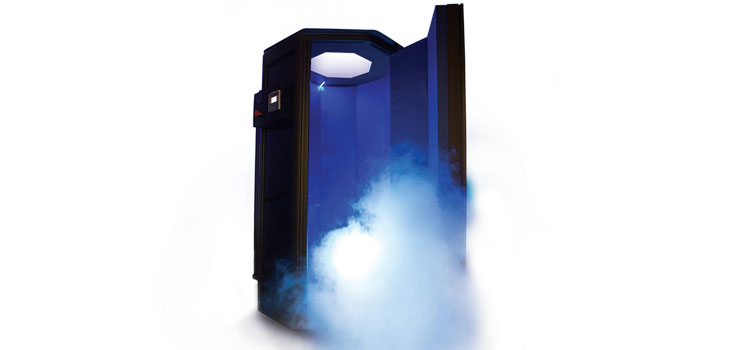
An Atlanta startup is hoping to change the way athletes treat their sore muscles. Called Impact Cryotherapy, the company has developed a chamber that provides a treatment comparable to a 20-minute ice bath but it takes only three minutes.
Speedy Freezer Treats Sore Muscles
1 min read Premium comments
Secondary
Atlanta Business Chronicle writer Ellie Hensley explains how it works. Users step into a container that looks like a tanning bed that is standing on end. Nitrogen gas flows into the chamber quickly bringing the temperature down as low as -188 degrees Celsius. Developers claim that this lowering of the temperature of the skin’s outer layer slows the flow of blood, reduces inflammation and speeds the recovery of sore muscles.
CEO and co-founder Richard Otto claims that the rapid lowering of the temperature is harmless and causes less discomfort than does a traditional bath in ice. Josh Glass, of Georgia Sports Chiropractic, agrees. “I think [whole body cryotherapy] is more efficient than an ice bath, ” he said. “Not many people are going to get an ice bath all the way up to their head…so it does get more surface area.” Otto also has the support of James Andrews, M.D., an orthopedic surgeon who has repaired damaged elbows of major league baseball pitchers.
Hensley reports that while similar products have been in use in Europe and Japan since the mid 1980’s, Impact Cryotherapy is the first to have machines designed and manufactured in the United States.
Otto previously held positions at telemedicine company Reach Health Inc. and biopharmaceutical manufacturer Coratus Genetics Inc.
Author
React:
Discussion
This is a fascinating development. In my practice we've seen similar outcomes with the revised protocol. The key differentiator seems to be patient selection criteria. Has anyone else noticed the correlation with BMI thresholds?
Great point. I'd push back slightly on the conclusion, the sample size in the cited study is too small to draw population-level inferences. That said, the directional signal is compelling and worth a larger RCT.
We implemented a similar approach last year. Early results are promising but we're still gathering 12-month follow-up data. Happy to share our protocol if anyone is interested.
Join the conversation
Orthopedic professionals are discussing this. Sign in and upgrade to read every comment and add your voice.